GROWERBUDDY
Back to Garden Problems
Pests

Whitefly on Plants: Which Stage a Spray Reaches

Two readings taken at the plant decide whether a colony needs anything at all: one says whether it is still alive, the other whether something is already ending it. Both cost less than the spray they stand in for.

Small white insects rise off the leaves when a hand passes over them, and the leaf underneath is sticky. That much is unmistakable; what is not obvious is that the insects in the air are the least of the colony. The ones taking the crop down are flat, pale and glued to the leaf, and they have not moved since the day they hatched.

White insects on new growthSticky leavesBlack film on lower leaves
Reviewed & verified by GrowerBuddy Editorial TeamLast updated: 2026-10-23• Sources

Next Move

Use the calendar when the real problem is timing or weather.

Numbers build through warm, dry weather and peak late in the season, when plants have stopped growing and the colony has not. The planting calendar carries your own forecast beside the planting windows, so a last sowing can be timed to finish while the plants are still growing away from it.

Stage by stage

The insect you can see is not the one a spray reaches

The adults lift off the moment a hand passes over the plant. The ones that pull a crop down are glued flat to a leaf surface that has to be sprayed from underneath, and they never move again. Each stage sits at its own distance from the nozzle; check which one the plant in front of you is carrying.

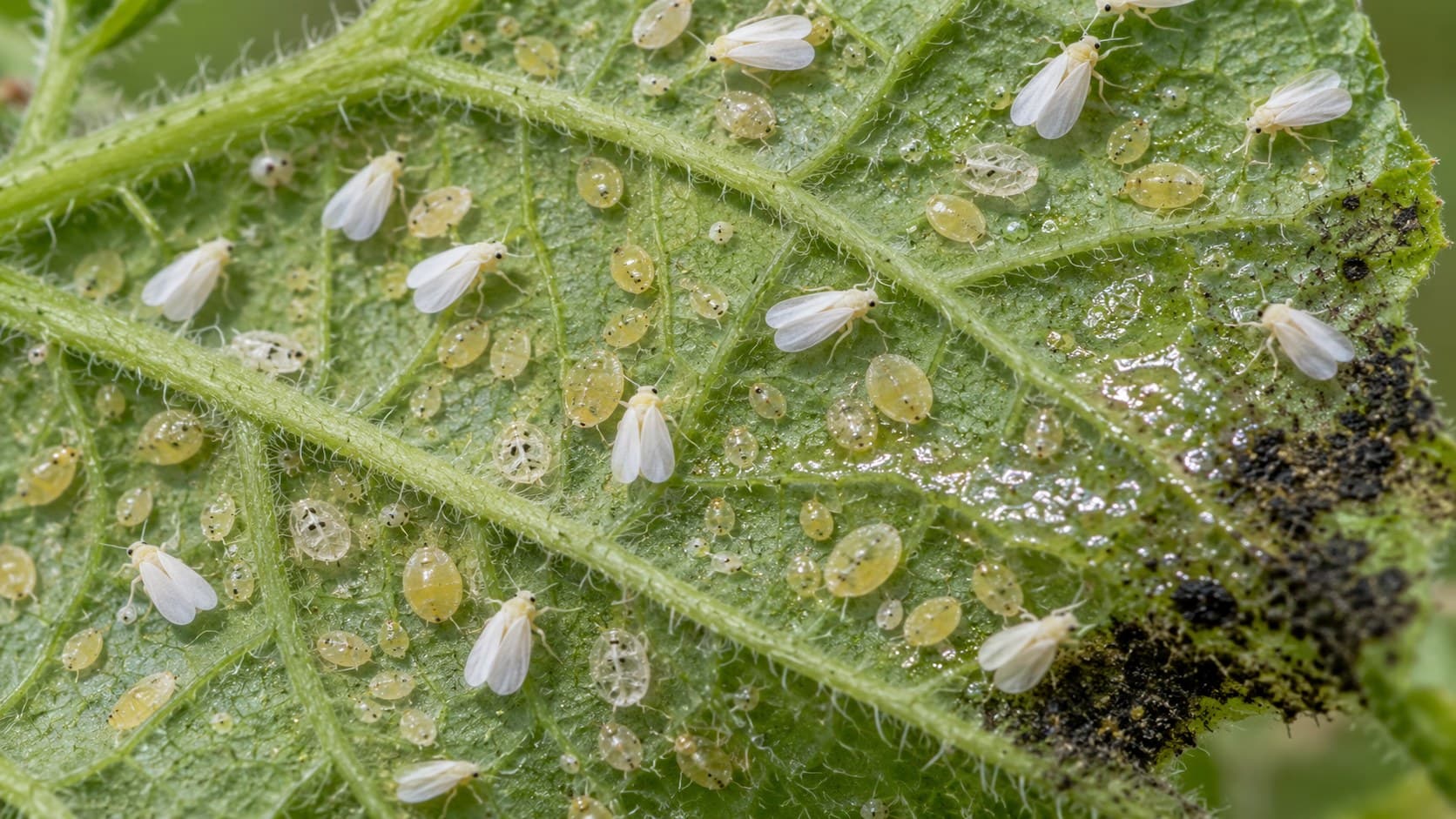
The underside of a tomato leaf carrying whitefly: white adults resting with their wings held flat, flat translucent yellow nymphs fixed to the surface, empty white cases, droplets of honeydew and a patch of black sooty mould at the leaf edge.

All four stages sit on the same leaf at the same time, which is why a product that works on one of them changes nothing about the others.

  1. Egg

    0.2 mm long

    University of Georgia IPM

    What you see

    Oval, pointed and about 0.2 mm long: pale yellow when it is laid, darkening at the tip in the day before it hatches. At that size it is a speck on the underside, not something to spot from standing height.

    Where it sits

    Set into the underside of the newest leaf an adult reached, which is why the growing tip of a plant is always the first place worth turning over.

    What a spray does to it

    Nothing sprayed on a leaf gets at an egg under its surface, so the eggs already in place are the reason one application does not finish an infestation.

  2. Crawler

    0.2 to 0.3 mm, mobile for a few hours

    University of Georgia IPM; UC Statewide IPM Program

    What you see

    The stage that hatches, 0.2 to 0.3 mm across and the only one that walks. It moves for a few hours, chooses a spot on the same leaf, and stays there for the rest of its life.

    Where it sits

    A short distance from the shell it came out of, on the underside of the same leaf.

    What a spray does to it

    The one immature stage a spray could meet, and the whole window is measured in hours. Catching it is luck, not method.

  3. Nymph, settled

    0.7 to 0.8 mm at the last nymph stage

    University of Georgia IPM

    What you see

    Flat, oval and translucent yellow, reaching 0.7 to 0.8 mm by the last stage, with red eye spots in the final days. No legs to speak of and no wax: it looks like a tiny scale insect and it does not move again.

    Where it sits

    The underside of a leaf, in one spot for weeks — and by then usually a leaf or two lower than the newest growth, because the shoot has grown past it.

    What a spray does to it

    Soap and oil kill only what they wet, and this sits on the face of the leaf that a spray from above never touches. It is the stage worth aiming at, and the stage hardest to reach.

  4. Adult

    0.9 to 1.2 mm long

    University of Georgia IPM

    What you see

    Wings held roof-like over a pale yellow body, 0.9 to 1.2 mm long, and white from the waxy coating that gives the insect its name. It lifts off in a small cloud when the plant is knocked.

    Where it sits

    In the air, settling on the newest growth to feed and to lay.

    What a spray does to it

    The stage most products are aimed at, and the one that can leave. Survivors lay again within days, which is why a knock-down that looks like a cure is followed by a second hatch a fortnight later.

A generation takes as little as 18 days at 86°F and as long as two months when it is cool, and a female lays 50 to 400 eggs — about 160 on average, two of every three of them female. A fortnight of warm weather is all the head start this insect needs — University of Georgia IPM.

Turn the leaf over

The same insects mean different things at the top and the bottom of a plant

This insect walks upward as it ages. Adults lay on the newest growth, and the offspring that survive finish on leaves that were new a month ago. Which band you find them in says whether this is this week's arrival or last month's, and those two are answered differently.

Read three leaves before deciding anything: one at the growing tip, one in the middle, one at the bottom. Two of them are usually clean, and the bottom one is the one nobody turns over.

  1. The newest leaves at the growing tip

    What you find

    Adults resting on the underside, often with eggs beside them, and the first crawlers a day or two after a warm spell.

    What it means

    This is the generation being placed now, and the only part of the colony still small enough to end by hand. It is also the part a spray from above misses, because every stage of it is underneath the leaf.

    What to do

    Turn the tip leaves over once a week. A colony found here can leave with the leaf, and the plant grows past the loss.

  2. The middle leaves you brush against

    What you find

    Settled nymphs, droplets of honeydew, and the first black film on the upper surface.

    What it means

    This is where the crop is paying for the colony. The nymphs are drawing from the same leaves that are filling the fruit, and the sticky film above them is a mould that grows on the sugar and shades the leaf under it.

    What to do

    Wash the honeydew off with a hose and take away the leaves that are more than half covered. The black film is not a second disease, and it stops spreading once the honeydew does.

  3. The oldest leaves at the bottom

    What you find

    Empty white cases stuck flat to the leaf, some with a T-shaped hole and some with a round one, on tissue that has yellowed or dried.

    What it means

    The cases are a generation that has already finished, and a leaf carrying nothing but cases has nothing left to treat. The shape of the hole is the more useful half of the reading: a round or oval one means something came out of the insect, and a T means an adult did.

    What to do

    Take the spent leaves off and bin them. Leave the spray alone on this band, because a spray here reaches the predators working on the generation above.

The bottom of the plant is where the yellowing shows first, and yellowing is also what too much water, too little nitrogen and cold soil look like. Finding the cases underneath is what separates a pest from a watering problem.

Before you treat anything

What else is on the leaf that is not a live colony

A leaf can carry something that came out of the potting mix, something that walked in from the shoot beside it, and the empty shells of insects that are already dead. The shells are the ones that read as an emergency, and they are the reading that saves the most spraying.

Handled wrongly, each of the three costs a spray that does nothing: one is a watering problem, one is the insect the cheap treatment does reach, and one is already finished.

  1. Fungus gnats

    The mark

    They fly low over the soil and the tray surface and rarely up around the leaves, and they are dark-bodied with long legs. The larvae are in the wet mix, not on the leaf.

    What it means for the crop

    A different insect with a different fix: the adults are a nuisance and the larvae are a watering problem. Nothing aimed at a leaf reaches them in the potting mix.

  2. Winged aphids

    The mark

    Two short tubes sticking out of the rear end. Whiteflies have none, and a winged aphid is nearly always standing among wingless ones on the same shoot.

    What it means for the crop

    Soap and water do reach aphids, which makes this the reading where the cheap treatment works. It also means the wax and the white colour that sent you looking are not here.

  3. Empty cases and cast skins

    The mark

    Flat, opaque, papery white, stuck down and empty. Nothing inside, and no movement if a fingertip touches one; a live nymph is translucent and soft.

    What it means for the crop

    This is the reading that ends treatment. The cases are what a finished generation leaves behind, and a leaf carrying only cases needs nothing.

Colour settles none of these three. The mark does, and all three marks can be checked without a lens.

Two minutes, two answers

Decide whether to treat at all before deciding what to treat with

The first reading says whether what you are looking at is still alive and still settling. The second says whether something is already killing the colony, which turns the plan from spraying into waiting.

Both readings are taken on the oldest leaves, where the finished generation left its cases. Neither needs a lens, and neither costs anything.

The tap test

Is anything still alive on this leaf, or am I looking at the shells of an insect that has finished?

How to run it

  1. Hold a sheet of white paper under the leaf you found the insects on.
  2. Tap the leaf two or three times with a finger.
  3. Wait a few seconds, then look at the paper.

If it comes out one way

Insects that fly or crawl on the paper mean a live colony, and the leaf underside above the paper is where the nymphs are.

If it comes out the other

Papery white flecks that do not move mean the cases were empty. Nothing on that leaf needs anything.

Adults lift off when a plant is disturbed, and they do not fly far, so what leaves the plant is the colony that was on it.UC Statewide IPM Program

The exit-hole test

Is anything already working through the colony?

How to run it

  1. Turn the oldest leaves over and look at the white cases with a hand lens or a phone camera at full zoom.
  2. Find the hole each case carries.
  3. Read the shape: round or oval in one, and a T in the other.

If it comes out one way

A round or oval hole means a parasitic wasp came out of that insect, so something is already at work on the colony. Hold the spray and look again in a week.

If it comes out the other

A T-shaped hole means a healthy adult came out and nothing is working on it yet. Take those leaves off and keep watching the newest growth.

A round or oval exit hole is a parasite's; a T-shaped one is a healthy adult's.UC Statewide IPM Program

The order of work

What to do this week, and what only matters before the next planting

Work down the list and stop when the plant stops losing leaves. A plant that has settled after the second step does not need the rest, and most home plantings stop there.

The list is ordered by what each step costs and whether it can be taken back. The four that cost nothing come first, because on a plant carrying a few infested leaves they are the whole answer; the bottle comes fifth, after the ants and the dust, because it is the step that cannot be undone; and the two that belong to the next planting close it.

  1. Count before you buy anything

    Open until:
    now, then once a week
    Cost:
    nothing

    Tap three leaves — one at the growing tip, one in the middle, one near the bottom — over a sheet of paper, and write the number down. The count is what shows whether the colony is still growing, and the only way to find out whether the last thing you did worked.

  2. Wash the adults off

    Open until:
    mornings, before the heat
    Cost:
    nothing

    A hard jet of water knocks adults off the plant and they do not fly far enough to come straight back. It does nothing to the nymphs, so it slows the egg-laying while the rest of the work happens; it is not a treatment on its own.

  3. Take off the leaves that are white underneath

    Open until:
    while the colony is still on a few leaves
    Cost:
    ten minutes and a pair of pruners

    Nymphs cannot move, so a leaf carrying them is a leaf you can carry to the bin. Bag it instead of dropping it on the bed: a pulled leaf left on the soil is a colony with a new address.

  4. Cut off the ants, and the dust

    Open until:
    the whole season
    Cost:
    nothing

    Ants farm the colony and drive off the predators that would end it, so a line of ants going up the stem belongs to the problem. Dust does the same to the beneficials. Keep the bed watered and the paths damped down, and keep ants off the plant with a barrier or a band of sticky material around the stem.

  5. Spray the undersides, below 90°F

    Open until:
    early evening, on a plant that is not drought-stressed
    Cost:
    one bottle of horticultural soap or oil

    These products kill what they wet and nothing else, so every infested leaf has to be covered underneath — and the lowest leaves, which carry the most, are the hardest to reach. Spray in the evening so the leaf is not wet in direct sun, and leave a wilted plant alone until it has recovered.

    Apply below 90°F, and repeat once 7 to 10 days later.UC Statewide IPM Program

  6. Cover the soil under a new transplant

    Open until:
    at planting, and lift it when the heat arrives
    Cost:
    one roll of reflective mulch

    A shiny mulch repels the adults that would otherwise find a new transplant in its first fortnight, which buys the plant the weeks it needs to grow away. Lift it once summer temperatures peak, because the sheet that reflects the insect also heats the soil.

  7. Empty the bed, and the greenhouse, before the next planting

    Open until:
    after harvest; two weeks before anything new goes in
    Cost:
    an afternoon

    The colony moves from a finished crop to the next one, and under cover it does not need to go outside at all. Pull spent plants instead of leaving them to dry where they stand, and in a greenhouse or polytunnel take every host plant out for at least two weeks with nothing coming in. That clean break is the one step that empties a covered space.

Avoiding the broad sprays is part of the work, not an extra. Pyrethroids, carbaryl and foliar imidacloprid kill the predators and parasites that hold this insect down, and the outbreak on a sprayed plant is usually larger than the one that prompted the spray. Where a product is needed, soap and oil are the ones that leave the beneficials standing — UC Statewide IPM Program.

How it works

Why the adults are a symptom and the nymphs are the problem

The mechanism behind the advice, and why the same insect can be harmless on one plant and ruinous on the next.

What a settled nymph takes out of a leaf

An adult whitefly feeds lightly. The plant loss comes from the nymphs: a settled colony pulls sap from the same leaves that feed the fruit, and UC IPM puts the threshold plainly: significant losses do not happen unless there is a significant population of nymphs.

The stage that leaves and the stage that stays also differ in how long they last. Adults move on within days; a nymph under the leaf is there for weeks, which is what makes the underside the only place a treatment can still matter.

  • Adults on their own rarely cause significant damage.
  • The crop loss tracks the settled nymphs under the leaves.
  • A spray that misses the undersides has missed the stage that matters.

Why the leaf goes sticky, then black

Whiteflies feed on phloem, the tissue that carries sugar around the plant, and they take far more liquid than they need. The surplus comes out the other end as honeydew, and honeydew is what makes a leaf feel tacky and what a black mould grows on.

The mould is a symptom rather than a second disease: it needs the sugar to grow and it stops when the sugar stops. Ants are drawn to that sugar in the same way, and ants are worth taking seriously, because they defend the colony against the predators and parasites that would otherwise cut it down.

  • The sticky film is honeydew; the black film is a mould feeding on it.
  • Washing the honeydew off helps the leaf; it does not remove the colony.
  • Ants on the plant protect the colony — and dust on the leaves does the same for it.

What ends a colony without a spray

Whiteflies have a long list of enemies: lacewings, big-eyed bugs, minute pirate bugs and several small lady beetles eat them, and a group of tiny parasitic wasps lays its eggs inside the nymphs. In a garden where those insects have not been killed off, an outbreak often collapses on its own, which is why the exit-hole reading decides so much.

The enemies are also the reason the broad sprays backfire. Pyrethroids, carbaryl and foliar imidacloprid are all named as disruptive, and the pattern after them is the familiar one: the predators go first, the pest comes back without them, and the second outbreak is worse than the first.

  • Predators and parasites do most of the work in an unsprayed garden.
  • Round holes in the empty cases mean the parasites have found the colony.
  • Broad-spectrum sprays remove the enemies faster than they remove the pest.

The one case where the flying stage is the dangerous one

In tomato, cucurbit and bean crops the larger share of the damage is done by viruses that whiteflies carry from plant to plant. When a virus is present in the area, even a low number of adults can cost a crop, because the insect does not have to build a colony to move the pathogen.

That changes the arithmetic and nothing else. The adults still cannot be sprayed out of the sky, so what works in a virus year is the same as in any other: keep the numbers low from the start, keep the natural enemies in place, and use a resistant variety where one exists for the crop.

  • In tomato, cucurbits and beans, virus transmission is the main damage.
  • With a virus in the area, low adult numbers can still matter.
  • Preventing the colony is the only reliable route in those crops.
Sources used for this guide

The diagnostic guidance draws on the references listed below.

FAQ

Quick answers before you treat the plant

What is on the leaf, whether it is hurting the plant, and why the last spray did not end it.

What kills whiteflies instantly?

Nothing reliable. Insecticidal soaps and oils kill the insects they wet, which means full coverage of a leaf underside and a second application as the next generation hatches. The products that work systemically are also the ones that remove the predators, and whiteflies build resistance to them quickly. The fastest honest answer is that the adults will fly, the nymphs will not, and the nymphs are the ones worth killing.

Are whiteflies actually damaging my plants?

It depends on which stage is there and how many. A few adults on a tomato in August are usually nothing; a leaf with a settled colony underneath is losing yield, and in tomato, cucurbits and beans the risk is bigger than the feeding because whiteflies carry viruses between plants. Turn the leaves over before deciding, and tap one over paper to see whether anything is still alive.

Why do they come back after I spray?

For three reasons at once. The eggs under the leaf surface were never touched, the nymphs on the undersides were missed by anything sprayed from above, and new adults fly in from plants nearby. A fortnight is enough for the survivors to produce the next generation, which is why the timing of a second pass matters as much as the product.

Do yellow sticky traps get rid of whiteflies?

They lower the numbers and they tell you how many are arriving, but they will not end a colony on their own. Whiteflies do not fly far, so a garden needs a lot of traps to make a difference: as many as one trap for every two large plants, with the sticky surface level with where the insects are — UC Statewide IPM Program. Treat the count on the trap as information first and as control second.

Are the little white insects on my seedlings fungus gnats?

Usually yes if they are over the potting mix and running on the surface, and no if they are resting on the leaves and lift off in a cloud. Fungus gnats are dark with long legs and their larvae are in the wet soil; whitefly adults are white and their nymphs are stuck to the leaf. The two need different answers, so it is worth settling before buying anything.

Do whiteflies survive the winter?

In warm regions they breed all year and move from one host plant to the next, and under cover — a greenhouse, a polytunnel, a windowsill of overwintering plants — they never face a winter at all. Outdoors in a cold winter the population is knocked back hard. Either way, pulling spent plants at the end of the season lowers the number that starts again, and a covered space emptied of host plants for two weeks is cleared completely.

Related Problems

Keep troubleshooting from the right starting point

If this was not the exact symptom you meant, jump back to the hub or compare it with the other common problem guides.

Open the full hub