Aphids on Plants: The Count That Says Whether to Act
Aphids are the one garden pest a spray is usually the wrong answer to, because the colony is often already collapsing and the spray takes the collapse with it. What decides it is a number, not a symptom.
A colony of small soft-bodied insects on the newest growth, usually with a sticky film on the leaves below it: that is the picture most people are searching with. The useful next step is not a product, it is a count taken in the right unit and compared against what the crop will carry.
Next Move
Use the calendar when the real problem is timing or weather.
How hard a colony lands depends on how fast the crop is growing and how hot the week is, and both of those come from your own weather rather than from a calendar. The planting calendar carries your recent lows and the window each crop wants, so you can see whether the plants under attack are still putting on growth or already slowing down.
Not everything on the shoot is the colony
The colony has a look-alike and it has predators, and both are easy to spray by mistake. Check the mark on each one before you decide anything.
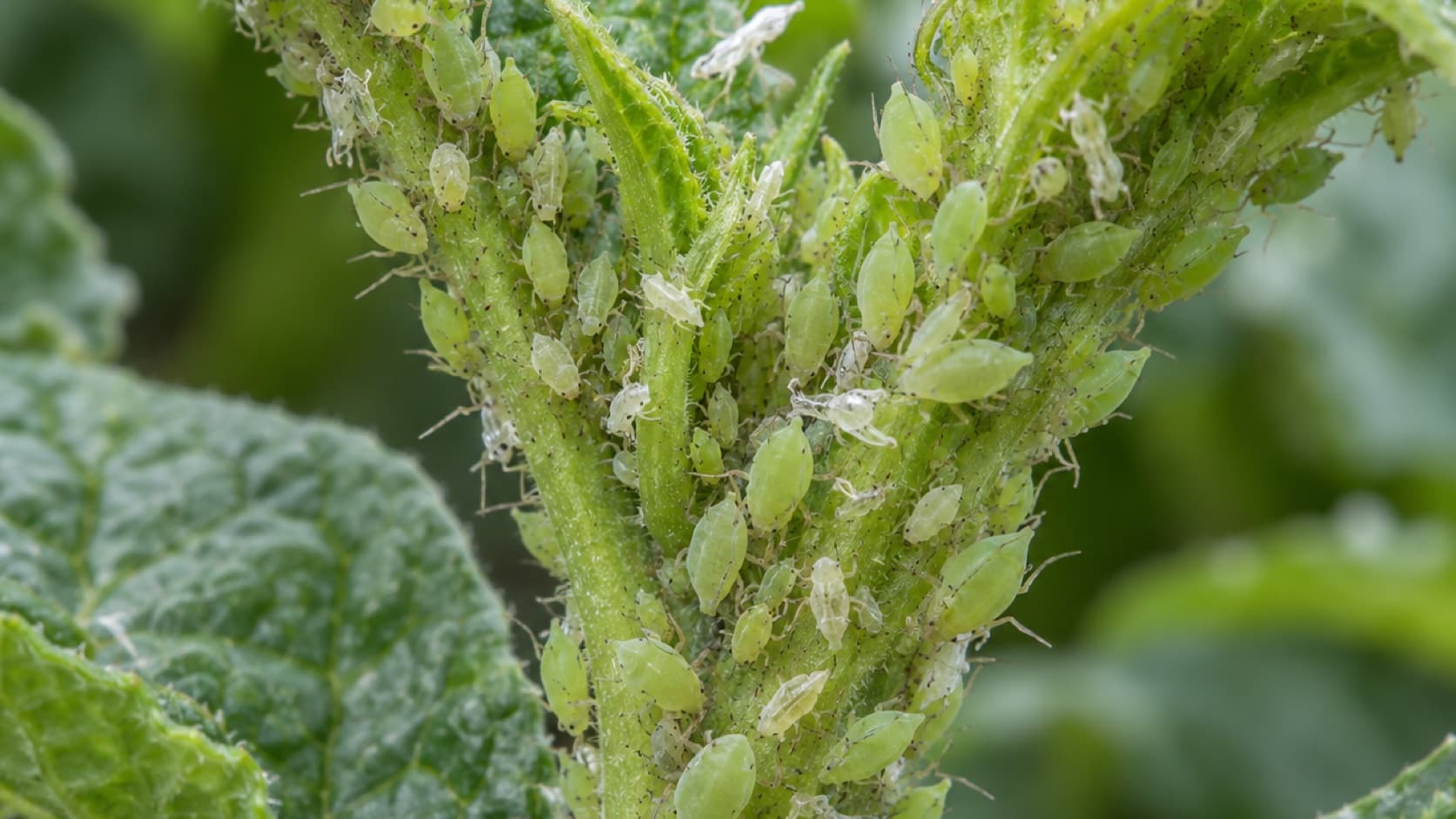
An aphid colony
The mark
Two short tubes sticking out of the rear end, like a pair of tailpipes. Nothing else in the garden has them, and on a full colony they are visible without a lens.
What it means
Cornicles are the one feature that separates aphids from every other small insect on a plant, which matters because colour does not: the same species runs green, yellow, pink, red or black depending on what it has been feeding on.
What to do
Count them before you do anything else, because the count decides whether anything needs doing at all. Most are 2 to 4 mm long and cluster on the underside of new leaves and around buds, so turn the shoot over.
Whiteflies, mealybugs or scale
The mark
Disturb the shoot: whitefly adults lift off in a small cloud, mealybugs are white and cottony and crawl slowly, and scale does not move at all once it has settled.
What it means
All four groups make honeydew and all four can blacken a leaf with sooty mould, so the sticky residue alone does not tell you which one you have. The controls are not interchangeable, and a spray aimed at aphids does nothing for settled scale.
What to do
Re-check the mark before buying anything. If the insects fly, or wear a white waxy coat, or sit still under a shell, this is a different problem with a different answer.
A syrphid fly larva
The mark
Maggot-shaped and legless, tapering towards the head, usually greenish or brown and up to about 2 cm. It has no true legs, which is the giveaway against a lady beetle larva.
What it means
This is a hoverfly in its larval stage, and it is on the shoot for one reason: to eat the colony. It is one of the predators that arrives after the aphids do, which is exactly why a colony looks like nothing is helping for the first week or two.
What to do
Leave it. Spraying now removes the predator along with the pest, and the pest comes back faster than the predator does.
A mummy, or a lady beetle larva
The mark
A mummy is a swollen, crusty, golden-brown aphid stuck to the leaf, often with a neat round hole where something has emerged. A lady beetle larva looks like a tiny armoured alligator.
What it means
The mummy is what is left of an aphid after a parasitic wasp has finished with it, and it means the colony is already being reduced from the inside. This is the single most useful thing to find on an infested shoot.
What to do
Hold off and re-count in a few days rather than spraying. Once mummies are common the population usually falls substantially on its own within a week or two.
Why the count you took today is already out of date
This is the part a spray cannot change. There is no mating and no egg-laying pause in summer, so the colony is compounding on a fixed interval rather than growing by ones.
A colony does not grow by ones, and this is the part a spray cannot change. In summer there is no mating and no egg stage to interrupt: the females give birth to live young that are already female, so every individual is a reproducing individual, and the interval between one generation and the next is short enough to matter inside a single week.
On the plant
One female, no mate
In over 20 to 30 daysBecomes
60 to 100 live young
She does not need to find a mate and she does not lay eggs, so there is no waiting period before the next generation starts. The offspring are born live and are all female, which is what removes the bottleneck a two-parent insect would have.
the reproductive output of a single aphid — University of Wisconsin-Madison Extension
On the plant
Each new nymph
In in about a weekBecomes
An adult giving birth herself
This is the number that makes a week of inattention expensive. The generation you can see is already overlapping with the one that will replace it, which is why a colony that looked manageable on Sunday can look alarming by Friday.
the generation time in warm weather — University of Wisconsin-Madison Extension
On the plant
One adult, one day
In in a single dayBecomes
Up to 12 juveniles
Multiply that by the adults already on the shoot and the direction of the colony is easy to read. It also explains why a contact spray that misses a few adults can look like it failed: the survivors are the entire next generation.
the daily rate for a single female — University of Maryland Extension
The arithmetic is also the argument against waiting for a spray to be convenient. The colony you leave this week is not the same size as the one you counted, and the growth is faster in warm weather and slower in cool, which is why the count matters more than the date.
The count the crop tolerates, and the unit to take it in
Most plants carry some of these without losing yield, so the useful question is not whether they are present but whether the number has reached the line. The unit matters as much as the number: a count per leaf and a count per plant are not the same count.
Most plants carry some aphids without losing anything, and one extension service puts it plainly: treating aphids for the health of the plant is usually unnecessary, and in many cases there are no visible symptoms at all. So the question is not whether they are present. It is whether the number has reached the line, and the line is set per crop because the damage a colony does depends on what the plant is doing with its energy.
Peppers and tomatoes
2 per leaf before fruit, 4 per leaf once fruit is present
Take the count
Green peach aphid. Pick a leaf from the middle of the plant and count the aphids on it; check several leaves, not one.
At that count
The line doubles when the plant starts filling fruit, because the plant has more to lose and less energy to spare. Below the line the plant outgrows the feeding.
Potatoes
2 per leaf before bloom, 4 during bloom, 10 within two weeks of vine kill
Take the count
Potato aphid and green peach aphid. Take it the same way: a count per leaf.
At that count
The line rises as the crop finishes, because a plant that is nearly done has less yield left to protect. Late-season counts that would have mattered in June do not matter in August.
Cucumbers, melons and squash
1 per leaf before bloom, 2 during bloom, 5 within two weeks of vine kill
Take the count
Melon aphid. On trained cucumbers a second reading applies: more than 20% of runners carrying 5 or more aphids on the leaves.
At that count
The lowest line any of these crops carries, and it applies earliest. Cucurbits are also the group where aphid-borne viruses do the real damage, and a virus moves at counts this low.
Beans
5 or more aphids per growing tip, on half the plants
Take the count
Bean aphid. The unit is the terminal, the growing tip of the shoot, not the leaf.
At that count
The unit changes and the meaning changes with it: this is a count of how widespread the colony is, not how dense it is, so a few heavily loaded plants do not reach the line on their own.
Cabbage, broccoli and cauliflower
2% of plants carrying 5 or more aphids
Take the count
Cabbage aphid. Sample a row and count plants, not leaves.
At that count
The strictest line by a wide margin, because the harvested part is the part the colony is sitting in. A crop grown for its leaves has nowhere to hide the damage.
These are the counts at which control is suggested for a commercial crop, which makes them a ceiling for a home garden rather than a target to spray at. Nothing here says a plant below the line needs anything, and a plant above it still may not: the colony may already be collapsing, which is the other reason to wait.
Two signs that say the answer is already on its way
Predators arrive after the colony does, which is why the first week of an infestation looks like nothing is helping. These are the marks that mean it has started.
Two things decide whether the colony is going to resolve itself, and both are things you can see rather than measure. One is already on the shoot, and the other is in the forecast.
Within a week or two
how fast the population falls once mummies are common — UC Statewide IPM Program
Parasitic wasps and the predators that follow them do not appear until the aphids are numerous, because there is nothing to eat before that. The lag is why the first week looks hopeless and why spraying then is the worst-timed intervention available: you would be removing the generation of predators that was about to do the work for you.
65°F to 80°F
the range in which most aphid species do their greatest damage — UC Statewide IPM Program
Aphid damage concentrates in warm-but-not-hot weather, and many species are intolerant of real heat: some colonies are simply gone by midsummer. A colony found in a cool, humid stretch is being helped by the weather, and the same colony in a heatwave is already on its way out.
What to do this week, then what to change before the next planting
Work down the list and stop when the count drops. The free and reversible steps come first, and for most home plantings they are the whole answer.
This week
Knock them off with water
What it costsA hose and a few minutes, repeatable
A strong spray dislodges the colony and washes off the honeydew at the same time, and most of the aphids that land on the ground do not find their way back up. Do it early in the day so the foliage dries in the sun, and repeat it every few days while the count stays high.
Prune out the curled shoots
What it costsThe new growth you cut, which the plant can replace
Once a leaf has curled it shelters the colony from both sprays and predators, so those leaves are the hardest part of the infestation to reach and the easiest to remove. Take the worst shoots and bin them rather than composting them.
Deal with the ants
What it costsA barrier or a few days of attention
Ants farm aphids for the honeydew and will actively drive off the predators and parasites that were going to end the colony. If you can see ants running up the stem, that is the reason the natural enemies are not working, and managing the ants does more than spraying the aphids would.
Stop feeding nitrogen
What it costsNothing, and it may save a feeding
High nitrogen makes the plant produce the soft, fast growth aphids prefer, and it favours their reproduction directly. If you are feeding a leafy crop hard, that is part of why the colony is where it is.
Before the next planting
Check transplants before they go in
What it costsA minute per tray
A colony arriving on a nursery transplant starts ahead of any predator in your garden, and it is the commonest way an infestation begins in a bed that had none. Look at the new growth and the underside of the leaves before planting, and turn away anything carrying a colony.
Cover or mulch the seedlings
What it costsA row cover or a roll of reflective mulch
Seedlings are the stage that suffers most, and both a floating cover and a silver reflective mulch reduce the numbers that find them. The reflective mulch also repels incoming aphids rather than only blocking them, which matters for the viruses they carry.
Feed with slow-release nitrogen
What it costsChoosing a different product
The same total nitrogen delivered in small amounts through the season does less to invite a colony than one heavy dose, and a less soluble form is the version that keeps the plant growing steadily rather than lushly.
What the plant does next
The colony is the smaller half of the damage. What the plant already lost is what decides whether the crop still finishes.
Leaves curled, still green and firm
The distortion is permanent on those leaves, but the plant is not losing them. Curling is a reaction to feeding, not a sign the leaf is dying, and a leaf that is still green is still paying for itself.
What to doLeave them and watch the new growth instead. If the leaves coming out at the tip are flat and full-sized, the plant has moved past the colony regardless of what the old leaves look like.
Leaves curled, yellowing or crisping at the edges
These leaves are on their way out and they are also sheltering the colony, so they are worth removing for two reasons at once. A plant that has lost its lower leaves to this is still able to finish if the tip is growing.
What to doTake the yellowing leaves and bin them, then re-count what is left on the shoot. Removing the shelter is often what finally exposes the colony to the predators that were already there.
Growing tip distorted and not extending
This is the case worth attention, because the plant has stopped replacing what it is losing. A shoot tip that is not moving after a week of a high count is where aphids stop being cosmetic.
What to doAct on the count rather than on the calendar, and check the stem for ants before choosing anything. If the tip starts extending again, the colony has lost and the rest is recovery.
Why this happens, and why the numbers hold
The mechanism behind the counts, and the parts of the advice that come from a field trial rather than from a product label.
Why a spray is usually the wrong first move
Most of the advice on aphids ends in a product, and the sources are unusually blunt about that. One extension service states that treating aphids for the health of the plant is usually unnecessary, and that in many cases there are no visible symptoms of feeding at all. Most plants carry one or more aphid species, and an established plant usually outgrows the damage.
That is not a claim that aphids never matter. It is a claim about what a spray does when it is applied to a colony that was already being eaten from the inside. Soaps and oils kill by smothering, which means they kill only the insects present on the day they are sprayed, and they leave no residue to catch the ones that arrive afterwards. On a colony with mummies in it, that is the predators as much as the pests.
The other half of the argument is arithmetic. A spray that misses a handful of adults has not set the colony back a handful of adults; it has left the entire next generation in place, and that generation arrives within about a week. The conditions that favour the colony are the same ones that favour a rebound, which is why the sources put the emphasis on repeated mechanical removal rather than on a single application.
Where the honeydew comes from, and what it is telling you
The sticky film on the leaves below a colony is honeydew, the sugary waste the aphids excrete after feeding on sap. It is worth knowing what it is for two reasons. It is usually what the reader notices first, sometimes before they have found the insects; and it is what the ants are farming, which is why an ant trail up a stem is a clue about the colony rather than a separate nuisance.
Left alone, honeydew collects dust and grows sooty mould, a black fungus that coats the leaf surface and blocks the light the leaf needs. The mould is a symptom rather than a second problem: washing the honeydew off with the same strong water spray that dislodges the aphids removes the food supply for it as well.
Honeydew also does not identify the insect. Whiteflies, mealybugs and soft scale all produce it, which is why the sticky residue alone is not enough to start treating anything. The mark that settles it is on the insect, not on the leaf: the cornicles for an aphid, the white waxy coat for a mealybug, the shell for scale, and the small cloud of flying adults for whiteflies.
The damage a count does not capture
The colony feeding on the plant is the visible problem, and it is the one the counts measure. There is a second problem that the counts do not measure, and it is the reason the cucurbit thresholds are the lowest: some aphid species transmit plant viruses, and the transmission happens in minutes rather than days.
An aphid probing a plant to test whether it is worth feeding on can pick up or deliver a virus in that first short probe, which means an insecticide has no chance to act before the infection has already happened. This is why the sources are careful to say that virus losses are difficult to prevent by controlling aphids, and why they put the weight on preventing the colony from arriving at all: covers on seedlings, reflective mulches, and never planting out a transplant that is already carrying insects.
For a home grower this changes what the numbers mean. A count above the line on a cucumber plant is more urgent than the same count on a potato plant, not because the feeding is worse but because of what else the insect may be carrying. The control that fits that risk is the one applied before the aphids land, which is the reason to start with clean transplants and a cover rather than with a spray.
The diagnostic guidance draws on the references listed below.
- University of Maryland Extension: Aphids in Home Gardens
- UC Statewide IPM Program: Aphids
- University of Maryland Extension: IPM Threshold Guide for Vegetable Crops
- Wisconsin Horticulture, University of Wisconsin-Madison Division of Extension: Aphids, in-depth
- University of Minnesota Extension: Aphids in Home Yards and Gardens
- UC Statewide IPM Program: Syrphids (Flower Flies, or Hover Flies)
Quick answers before you treat the plant
The questions that come up once you have counted the colony, answered without the steps that only apply to a farm.
Are the little green bugs on my plants always aphids?
No, and the colour is the reason to check rather than assume. Aphids come in green, yellow, pink, red and black depending on the species and what they have been feeding on, so a green insect is not automatically an aphid and an aphid is not always green. The reliable mark is the pair of cornicles at the rear end, which no other garden insect has.
Should I use soapy water or a dish soap mix?
If you use anything, use a product labelled as insecticidal soap rather than a kitchen mix, because a homemade one has no stated concentration and can burn the leaves. Even the labelled products only work on contact, kill only the aphids present that day, need thorough coverage of the undersides, and should not be applied to a water-stressed plant or above about 90°F. Given how often a colony is already being reduced by predators, the water spray is usually the better first attempt.
The aphids came back a few days after I sprayed. Why?
Most likely because a few adults survived somewhere the spray did not reach, and one surviving adult is enough: females give birth to live young without mating, and a nymph can be reproducing within about a week. Leaves that have already curled protect the colony from contact sprays, which is why removing those leaves matters more than spraying them again.
Do I need to remove the plants?
Rarely. An established plant usually outgrows aphid feeding, and the marks that decide it are on the new growth rather than on the older leaves. If the growing tip is still extending, the plant is winning. Pulling a plant is the last option, and it is the one that also removes whatever predators had settled on it.
How often should I be looking?
About twice a week while the plants are growing fast, which is when a colony can change the answer between one visit and the next. Check the undersides of new leaves and around the buds, and check the upwind edge of the garden and any plant that shares a species with something already infested, because those are where colonies tend to start.
Will lady beetles from a shop fix it?
The research is not encouraging. One heavily infested rose bush needed two applications a week apart of about 1,500 lady beetles each, and most released adults fly off within days if they are let go in daylight. Conserving the predators already in the garden does more, which mostly means not spraying them and dealing with the ants that are driving them off.
Keep troubleshooting from the right starting point
If this was not the exact symptom you meant, jump back to the hub or compare it with the other common problem guides.
All Garden Problems
Return to the main troubleshooting hub to compare the quick triage and all four featured problem guides.
Back to the hub
Topic
Vegetable Garden Basics
Beginner-friendly setup, layout, and planting-timing guides for growers building a practical home vegetable garden.
Why Cucumber Leaves Are Curling (Up vs Down: Causes & Fixes)
Narrow it down between heat, pests, watering swings, and early disease pressure.
Why Pepper Plants Are Not Growing and What to Check First
Three checks — night temperature, root room, and direct sun — and what each visible pattern points at.
Guide
How to Start a Vegetable Garden: 5 Practical Steps
Starting a vegetable garden? Use five beginner steps to choose the site, size the first bed, prepare the soil, and pick manageable crops.