Powdery Mildew on Plants: Which Leaves Are Already Lost
Powdery mildew does not need wet leaves, so the careful watering that keeps other fungi off your plants never protected them from this one. Nothing brings an infected leaf back, and the useful question is which tissue is still clean.
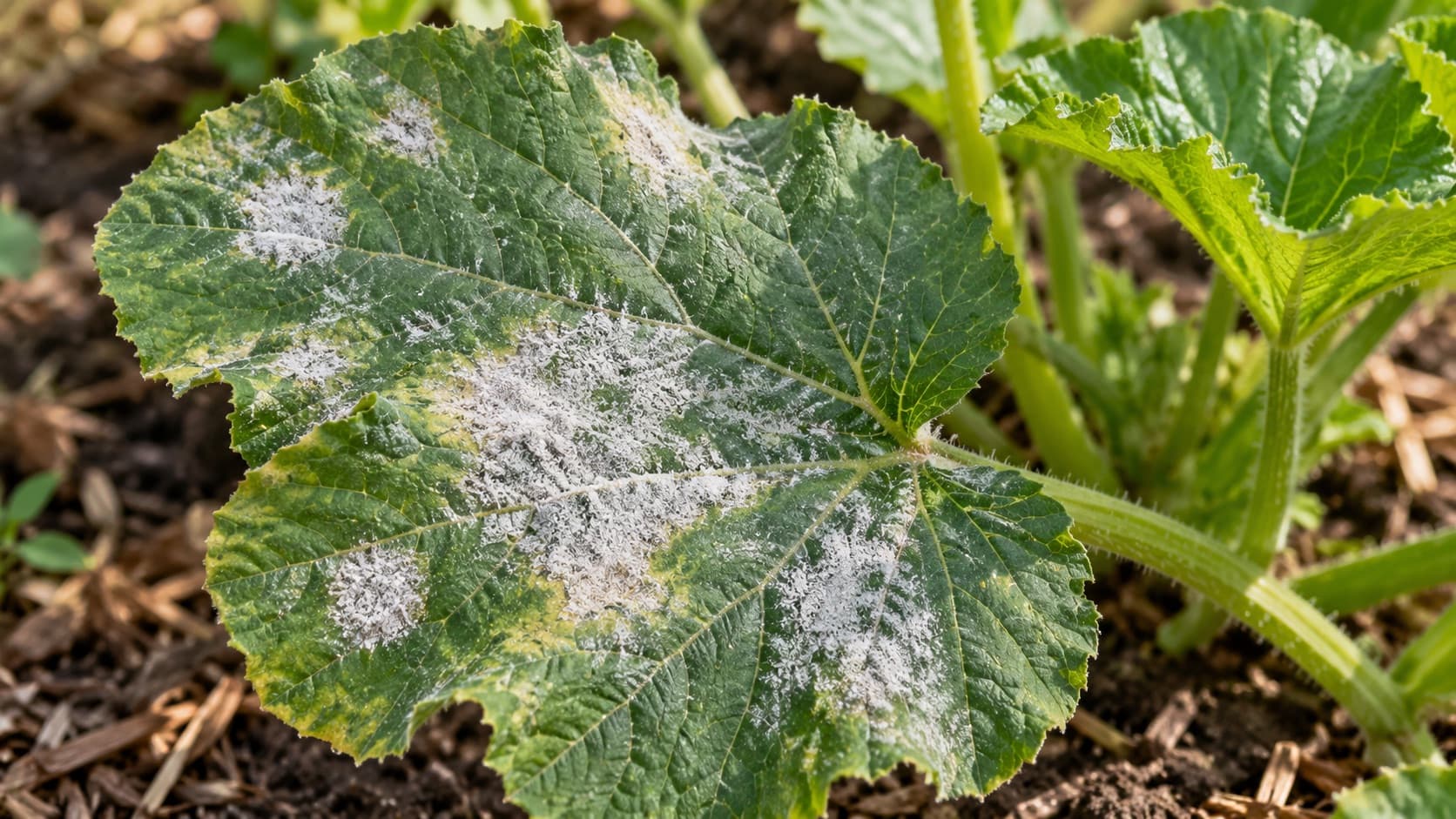
A white, flour-like dust spreading over the upper surface of the leaves is the picture most people arrive with. The first useful reading is that the coating is dry: it sits on top of the leaf rather than coming up through it, it appears in weather that keeps downy mildew away, and the plant underneath is already yellowing where the patches have been longest. What decides the rest of the season is which leaves are in which state.
Next Move
Use the calendar when the real problem is timing or weather.
This disease runs on its own weather rather than on the calendar, and the two numbers that decide how bad a year it is - how warm the days are and how humid the nights are - come from your own location rather than from a planting date. The planting calendar carries your recent lows and the window each crop wants, so you can see whether the plants under attack are still putting on the clean growth that carries the crop.
The condition you probably have backwards
What decides whether this keeps spreading is rarely the thing you have been working on. Work out which condition is doing the work in this bed, and which one change moves it, before spending anything on a remedy.
The habit that protects a garden from most leaf fungi is the one that leaves it open to this one. Downy mildew, blights, rusts and most leaf spots need free water sitting on the leaf before their spores will germinate, which is why watering at the base and keeping the foliage dry is the standard advice. This fungus is the exception: its spores germinate in humid air, and free water on the leaf stops them instead of helping them. A grower who has been watering carefully all summer has not been protecting the plants from this, and the same grower is more likely to be the one who gets it, because the driest gardens are often the ones with the least airflow between the plants.
Humidity in the canopy, not water on the leaf
97-99% at night, 40-70% during the day
the relative humidity the spores germinate in, and the daytime range that lets them spread — New Mexico State University Plant Clinic
Where you see it
The patches appear first on the lower and shaded leaves and on the undersides, which is where the air sits stillest and the humidity holds longest. The leaves near the top of the plant, in the sun and in the wind, stay clean for weeks after the bottom of the plant is covered.
The one change that shifts it
Open the canopy rather than change the watering. Thin crowded plants, take out the weeds around them, and stop feeding nitrogen late in the season.
Warm days with cool, humid nights
60°F to 80°F, and 70°F to 80°F for the fastest spread
the temperature window the disease develops in, and the narrower one the fastest spread happens in — Clemson University HGIC and Colorado State University Extension
Where you see it
Late spring and early autumn are the two windows, and a stretch of warm days with heavy dew is the one that moves fastest. Midsummer heat above about 90°F holds it back, which is why a garden that had it in June often looks cleaner in August and worse again in September.
The one change that shifts it
Nothing about the weather is changeable, which is why the rows below matter more than this one. What you can do is start looking on the lower leaves when the nights first turn humid, rather than waiting for the plant to look wrong.
Shade and still air
Infection rises as relative humidity approaches 90%
the humidity threshold at which infection increases — Colorado State University Extension
Where you see it
The plants that get it first are the ones in the shade, against a fence, under a tree, or on the crowded end of a bed. The disease is common in crowded plantings and in damp, shaded areas, and the lower leaves of a dense plant sit in both all day.
The one change that shifts it
Pick the sunny end of the bed for the cucurbits next year, and give the vines the spacing the seed packet asks for rather than the spacing the bed allows.
Soft, fast growth from heavy feeding
Young, succulent growth is the most susceptible tissue
the tissue the disease prefers, stated by extension services on both the Colorado and Nebraska publications — Colorado State University Extension
Where you see it
The newest leaves and the tips of the runners are the ones that carry the first patches on a heavily fed plant, and the leaf that grew in a week of generous nitrogen is thinner and softer than the one that grew slowly.
The one change that shifts it
Stop the late-season nitrogen, and if you feed at all, use a slow-release form so the plant grows steadily rather than in a flush.
The four conditions are not four causes to choose between; they stack. A shaded bed with crowded plants and a late nitrogen feed holds the humidity, keeps the air still, and grows exactly the tissue the fungus prefers, and the same bed in full sun with wider spacing has none of the three. That is also why the answer is rarely a product: the product treats the leaf, and the conditions are in the bed.
Which surface it is on, and what the leaf does when you wipe it
Some of the readings below need no treatment at all, and one of them is a more serious disease with the opposite requirement. Both tests are things you can do standing at the plant with a thumb.
Three things on a vegetable leaf look like this and are not it. Two of them do not need treating at all, and one of them is a much more serious disease with the opposite requirement - so the first two minutes are worth spending on the tests rather than on the remedy list.
Powdery mildew
Which surface
Either surface, but it starts on the upper surface of the lower, shaded leaves. On tomato it can also run along the stems and the leaf stalks, which is one of the few ways to tell which of the two tomato mildews you have.
When you wipe it
The white comes off on a finger and leaves a yellow or bronzed patch behind. The patch does not go green again, and the coating is back on the same spot within a week.
Threads and spores on the surface; the feeding structures inside the leaf cells
where the fungus is relative to the leaf surface, which is why the wipe reaches only part of it — Colorado State University Extension
A coating that wipes off and a leaf that stays yellow underneath is the reading that decides what happens next: the threads are on the surface, and the feeding structures are inside the leaf cells they are sitting on. That is why the surface can be cleaned and the leaf cannot be repaired.
Downy mildew
Which surface
The underside only. From above you see an angular yellow patch that stops at the veins and makes the leaf look quilted, and the growth is on the back of that patch rather than on the front.
When you wipe it
It wipes off the underside, and the patch on top stays. What separates it is the shape and the weather: the yellow areas are bordered by the veins rather than round, and the disease needs cool, wet conditions instead of dry ones.
Spores on the undersides only, in splotches bordered by the veins
the two features that separate the two mildews on sight, side by side in one table — UC Statewide IPM Program
This is the one confusion worth spending a minute on, because the two diseases want opposite conditions and the treatment for one does nothing for the other. Downy mildew arrives after rain or irrigation and spreads in wet weather; this disease spreads when the leaves stay dry.
Honeydew and sooty mould
Which surface
The upper surface, in a sticky film that collects dust and turns black. It is usually on the leaves below a colony of aphids, whiteflies, mealybugs or scale rather than spread evenly over the plant.
When you wipe it
It wipes off and the leaf underneath is green. That is the test: a film that comes off and leaves a healthy leaf was never growing on the plant.
A film that wipes off and leaves a green leaf
the reading that separates insect waste from a fungus growing on the tissue — UC Statewide IPM Program, on the two mildews, and University of New Hampshire Extension on what does the feeding
This is insect waste, not a fungus, so no fungicide touches it. Look on the undersides and the growing tips for the insects making it, because the film is the symptom and the colony is the problem.
A mineral or fertilizer deposit
Which surface
Wherever water dried: the leaf edges after a hard watering, the leaf under a mister, the rim of a pot, and the surface of the soil itself.
When you wipe it
It wipes off, and it often comes back on the same leaf edges after the next watering. The residue is gritty and crusty rather than powdery and fluffy, and it does not spread from leaf to leaf the way an infection does.
A white crystalline coating on the leaves, the pot rim and the soil surface
the deposits hard water and soluble fertilizer leave behind, and where they collect — University of Maryland Extension
Hard water leaves calcium and magnesium behind when it evaporates, and soluble fertilizer leaves salts in the same way. Neither is a disease, and both are a sign to water from the base and to flush the salts out of a container rather than to spray anything.
The wipe test settles three of the four, and it is worth doing before anything else, because two of these readings mean there is nothing to treat. What the test cannot settle is which of the two mildews is on the leaf, and that one comes down to surface, shape and weather.
What is finished, what is still working, and what is clean
A leaf that has this on it does not recover, and that is the fact most of the advice skips past. Read the plant from the oldest leaves up, and each band tells you what that tissue is still doing and what to do with it.
A leaf that has this on it does not recover. The threads are on the surface and the feeding structures are inside the cells, so removing the coating removes the part you can see and leaves the part that is taking the plant's sugar. Once the tissue around those feeding points has yellowed, that leaf is a net loss to the plant: it is still respiring and still losing water, and it is no longer paying for itself. The plant's answer is to drop it, which is what the yellowing leaves are on their way to doing.
- VerdictAlready lost
The oldest leaves at the base
Leaves 16 to 23 days after unfolding are the most susceptible
the leaf-age window in which infection takes hold most easily — University of Illinois Extension
What that tissue is doing
These are the leaves the disease reaches first and the ones it finishes first. They are the oldest tissue on the plant, they sit lowest in the canopy where the air is stillest, and they are the least able to pay for themselves even when they are healthy.
What to do with it
Take them off and bin them rather than composting them. Cutting them out is not treatment, it is removal of the part of the plant that is already finished and that is holding the humidity the next leaf needs.
- VerdictGoing, and worth removing
Leaves with yellow under the white
Severely infected leaves yellow, wither and die
what happens to a leaf once the infection is established in it — University of Illinois Extension
What that tissue is doing
The white is only part of what is on these leaves; the tissue between the veins has gone pale or yellow, and the leaf has started to draw on the plant rather than feed it. It will not turn back, whatever is sprayed on it.
What to do with it
Remove them, and remove them for two reasons: the leaf is a loss, and it is the nearest source of spores to the clean growth above it. Wash your hands or your gloves afterwards, because the spores travel on what touches them.
- VerdictStill working, and worth defending
Leaves with white patches and green between them
7 to 10 days from infection to visible spores
the latent period between a spore landing and the colony becoming visible — University of Nebraska-Lincoln Extension
What that tissue is doing
These leaves are still green in the areas the fungus has not reached, which means they are still making the sugars the fruit will be filled with. This is the tissue the salvage decision turns on: it is the part that decides how much crop the plant finishes with.
What to do with it
Leave them on. Protect them rather than clean them - the coating on the surface is not the problem, and rubbing it off damages the leaf and spreads spores to your hands.
- VerdictClean, and the whole point
The new growth at the tips
7 to 10 days for a new colony to appear on clean tissue
the same latent period, which is why a tip that is clean today is not a tip that is safe — University of Nebraska-Lincoln Extension
What that tissue is doing
On a plant that is still extending, the newest leaves and the tips of the runners are the tissue that carries the crop from here. They are also the tissue the disease prefers when the plant is being fed hard, so clean today is not the same as clean in a fortnight.
What to do with it
Watch it rather than treat it. If the tip keeps extending and the new leaves come out flat and full-sized, the plant is outrunning the disease and the crop still finishes.
10 to 20%
What the plant loses when the oldest leaves go early
the yield loss powdery mildew causes on cucurbits where no control is practised — University of Illinois Extension
That figure is the useful one for the decision, because it is the size of the loss rather than the size of the disease. A cucurbit plant that loses its oldest leaves early still fills fruit, and the loss lands on the fruit that ripens after the canopy is gone: fewer and smaller fruit, fruit that ripens early and incompletely, and fruit that sunburns because the leaves that would have shaded it are down. For a pumpkin or a winter squash the storage quality goes with it. So the decision between nursing a plant and pulling it is not usually close - a plant with clean growth at the tip is worth keeping, and a plant with nothing but infected leaves left is not worth the water.
From this leaf outward, and what that means for next spring
How far the next infection has to travel decides which of your other plants to check, and how much an autumn cleanup is worth. Read the distances outward and the two answers come apart.
Where the next infection comes from decides whether the work is worth doing, and the answer changes with distance. The fungus is host-specific: the one on your cucumbers is not the one on your roses and not the one on your grapes, which is why the plants you should check next are the ones in the same family rather than the ones nearest.
- On this plant
The spores the coating is already making
Thousands of spores from a single infection
the number of secondary spores one primary infection can go on to produce — Ohioline, Ohio State University Extension
The white coating is the fungus making spores, and the chains of them break off and travel on the wind. This is why the colony you can see today is not the colony you will have in a week, and why the leaves you remove are worth removing today rather than at the weekend.
- In this bed
The plants in the same family
Host-specific to a family rather than to a species
the host range of the powdery mildews, which is narrow enough that one will not jump to an unrelated crop — UMass Extension
The mildew on a cucumber will infect melons and squash, and the one on a tomato is a different fungus that will not. So the plants worth checking are the other cucurbits, or the other nightshades, rather than everything in the bed. A watermelon and a cucumber sit close enough for the spores to reach each other easily.
- Over winter
The debris in the bed
Survives as fruiting bodies on fallen leaves or as threads in infected plants
the two overwintering forms, and where they wait — New Mexico State University Plant Clinic
The fungus does not survive on its own in the soil: it needs living tissue or the resistant bodies it makes late in the season on fallen leaves, stems and buds. That is the whole case for autumn cleanup, and it is a real one - but it is also why the disease comes back in a garden that cleaned up perfectly, because the spores travel hundreds of miles on the wind and arrive from somewhere else.
- From elsewhere
The wind, and the transplants
Carried by wind to neighbouring plants, or hundreds of miles
the distances the spores travel on air — University of Minnesota Extension
This is the reason a bed that had nothing last year can have it this year, and the reason a fallow period is the only thing that genuinely breaks the cycle: the fungus needs a living host, so a season without a susceptible plant in that spot ends it there. Buying in transplants is the other route, and it is worth looking at the undersides before they go in the ground.
The last two rows are why autumn cleanup is worth doing and why it is not a guarantee. Clearing the debris reduces what starts in that bed next spring, and the wind replaces a good part of it either way - so the work is worth an afternoon, and it is not worth planning the season around.
The two jobs, and which of them is possible
Every method here is sold as a cure, and none of them is one. Reading across each row separates the job that is possible on clean tissue from the job that is not possible on tissue that already has it.
These are the things most people reach for first, and they are not all wrong. What separates them is which of the two jobs each one can actually do, because the two are not the same job and only one of them is possible on a leaf that already has the disease.
Protects clean tissue
Acts on an infection already there
Sulfur
Effective and inexpensive, but not above about 80°F
the standing verdict on sulfur, with the temperature above which it burns foliage — Utah State University Extension
Protects clean tissue
Yes, and it is the cheapest thing that does
Acts on an infection already there
No
Sulfur is the product extension services name first, and it is a protectant: it works on the tissue it lands on before the fungus does, and new leaves that grow after the spray are unprotected. It burns foliage in heat and some cucurbits are damaged by it, so it is a spring and autumn tool rather than a midsummer one.
Potassium bicarbonate
An effective contact treatment with no residual activity
the description of potassium bicarbonate as a contact fungicide — University of Arizona Extension
Protects clean tissue
Yes, on contact
Acts on an infection already there
No
This is the effective version of the baking-soda idea, and the difference matters: it is sold at a labelled concentration, where a kitchen mix has no stated rate and burns leaves. Contact means it kills what it lands on and leaves nothing behind, so it has to be reapplied as the plant grows.
Horticultural and plant oils
Do not use within two weeks of sulfur, or above 90°F
the two restrictions that come with an oil spray — Utah State University Extension
Protects clean tissue
Yes, with care
Acts on an infection already there
Partly, on woody plants
Oils can act on an existing colony rather than only in front of it, which is why they are the one thing on this list that does something to a leaf that already has patches. That still does not make the leaf green again: it kills the fungus on the surface, and the tissue it has already taken the sugars from stays yellow.
Milk, at 5% to 20%
Controls zucchini and cucumber mildew at 5-10%, weekly, comparably to a fungicide
the result of Embrapa's trials on zucchini and cucumber, sprayed weekly — Embrapa Meio Ambiente
Protects clean tissue
Partly
Acts on an infection already there
Partly
This is the one home remedy with a real trial behind it rather than an anecdote, and the sources do not agree on how to time it. Embrapa, which ran the original trials, tells growers to use it preventively and to spray the whole plant weekly, at 10% once the infestation is high. A later study from the same group found the curative effect stronger than the preventive one, and traced it to the milk depositing over the spores and feeding a microbial community on the leaf. Both are worth knowing before choosing: the label rate is 5 to 10% milk in water, and neither result is a cure for a leaf that has already yellowed.
Baking soda from the kitchen
1 tablespoon per gallon, and it can burn the leaves
the home mix rate, published with the warning that goes with it — University of Arizona Extension
Protects clean tissue
Partly, and unpredictably
Acts on an infection already there
No
The rate is real and the caveat is the important part: with no labelled concentration and no spreader, a kitchen mix burns foliage often enough that extension services publish the warning alongside the recipe. If the goal is bicarbonate, the labelled product costs about the same as the box and does not carry the risk.
Vinegar
Acetic acid is registered for seed treatment, not for this
the approved agricultural use of vinegar in the EU, which is treating seed and tools — EU CAP Network
Protects clean tissue
No reliable evidence
Acts on an infection already there
No
Vinegar's registered use in agriculture is disinfecting seed and cutting tools, and there is no extension trial behind it as a foliar treatment for this disease. It is an acid sprayed onto a leaf, and at a strength that does anything it also damages the leaf.
Wiping the coating off
The feeding structures stay inside the leaf cells
where the fungus is relative to the surface, and why the wipe only reaches part of it — Colorado State University Extension
Protects clean tissue
No
Acts on an infection already there
No
This is the one that feels like it should work, and the mechanism is why it does not. The threads and the spores are on the surface; the structures the fungus feeds through are inside the leaf cells underneath them. Wiping takes off what you can see, leaves what is doing the damage, and moves spores onto your hands and on to the next plant.
Nothing on this list restores a leaf, and the second column says so all the way down. That is not a reason to use none of them - a protectant applied to the clean tissue above an infection is doing real work on next week's leaves - but it is the reason a list of remedies cannot answer the question you arrived with. The first column is about the next leaf, and the leaves that already have patches are decided. Oregon State University Extension puts the same conclusion more bluntly for the home garden: pesticides are usually not warranted for this at all.
What can still be done this season, and what is next year's
The list runs by how soon each step stops being possible rather than by how much it matters. The first steps are only available while the plant still has clean tissue on it, and the last one cannot be done at all until you are buying seed.
The list is ordered by how soon each step stops being possible, because the ones at the top are the ones that are only available while the plant still has clean tissue on it.
Once the majority of leaves are affected, it is too late to treat
the point at which the extension services stop recommending a fungicide — University of Minnesota Extension
- The window
While the leaves are still attached
Take the finished leaves out today
What it costsTwenty minutes and a bag
Start at the base and work up, and take the leaves that are yellow between the veins rather than only the ones with the most white on them. Bin them rather than compost them, because a garden compost heap does not reliably reach the temperature that kills the resistant bodies. Wash your hands and your secateurs before you touch the clean plants.
- The window
This week, before the humidity builds
Open the canopy
What it costsThe plants you thin, and the weeds you pull
Thin the crowded end of the bed, tie the vines up rather than letting them run over each other, and clear the weeds that hold the air still around the base of the plant. The point is the humidity at the leaf surface rather than the look of the bed, so what matters is the gap between the leaves and the time the dew sits on them in the morning.
- The window
From now on
Move the water to the base
What it costsA different way of watering
Overhead watering raises the humidity inside the canopy and spreads spores by splash, so water at the soil line and in the morning. The one thing this does not do is protect the plant from this disease - keeping the leaves dry was never what stopped it - so treat this as one part of the humidity work rather than as the fix.
- The window
Now, and again next year
Stop the nitrogen for the season
What it costsNothing, and it saves a feed
Late nitrogen grows the soft, fast tissue the fungus prefers and makes the canopy denser at the same time. A plant that has been fed heavily all summer is the one most likely to have the disease and the one least able to outrun it, so the feed you do not give is doing more than the spray you might have bought.
- The window
At seed-buying time, which is the only time it is possible
Choose a resistant variety next year
What it costsThe price of the seed, and the variety you wanted
Resistance is available in cucumbers, melons and some squash, and it is the only control that works before the disease arrives rather than after. Resistant does not mean immune: the plants still get it, later in the season, which is the difference between a crop that finishes and one that does not. This is also the step that cannot be done in July, which is why it sits at the bottom of a list that is ordered by urgency rather than by importance.
- The window
After the crop, before the ground freezes
Clear the debris in autumn
What it costsAn afternoon
Take out the vines, the fallen leaves and the spent fruit rather than digging them in, because the fungus overwinters in the resistant bodies it makes on exactly that material. It is worth an afternoon and it is not a guarantee: the spores travel on the wind, so a clean bed can still be infected from a mile away next July.
Work down the list and stop when the plant has more clean tissue than infected. The first two steps are the ones that change the outcome this season, and they cost an afternoon between them. Everything below them is about next year, which is the honest answer to a disease that cannot be cured once it is in the leaf.
Why it arrives in dry weather, and why it comes back
What the coating is, what it is doing underneath, and where it waits between one crop and the next.
Why this fungus arrives in dry weather
Almost every leaf disease a home grower meets needs water on the leaf before it can start. Downy mildew, early blight, late blight, the rusts and most leaf spots all need a film of free water - from rain, from dew, or from a hose - for their spores to germinate, which is the reason the standard advice is to water at the base and keep the foliage dry. Powdery mildew is the exception that breaks the rule, and it breaks it in both directions: its spores germinate in humid air without any free water at all, and free water on the leaf inhibits them.
That is not a curiosity. It is the reason the disease is worst in the places where the other fungi are not: dry climates, dry seasons, and gardens where the grower has been careful. The mildew on cucurbits is a serious problem in drier growing seasons, precisely when it is too dry for downy mildew and the other leaf diseases to develop. A gardener who has spent the summer keeping water off the leaves has been doing the right thing for every disease except this one.
The humidity the fungus actually uses is the humidity in the air inside the canopy, which is not the same as water on the leaf. It needs very high humidity at night to make its spores and drier air during the day to move them, which is why a stretch of warm days with heavy dew and still mornings is the pattern that gets it going. The lower leaves of a crowded plant sit in exactly that, all day, and they are also the oldest tissue on the plant - which is why the two conditions show up in the same place.
- Free water on the leaf inhibits the spores rather than helping them, which is the opposite of downy mildew, blights and most leaf spots.
- The humidity that matters is inside the canopy, so spacing and pruning change it and the watering can barely touch it.
- The disease is worst in dry weather, which is why a dry season can be a bad year for this and a good one for everything else.
What the coating is, and what is underneath it
The white powder is made of the fungus's threads and its spores, and it is all on the outside of the plant. That is what makes this disease look trivial and what makes it so easy to treat wrongly: it is the one group of fungi that spends nearly all of its life on the surface, where a spray can reach it, rather than inside the tissue, where a spray cannot. It grows over the leaf rather than through it.
Underneath the surface layer the fungus pushes small feeding structures into the leaf cells. Those are the only parts of it inside the plant, and they are the reason the leaf does not recover. Once they are in, the fungus is drawing sugar out of cells that are still doing the work of making it, and the leaf is losing more than it produces. The yellowing you see between the patches is that loss showing up in the tissue.
The two facts together explain the page's whole argument. Because the fungus is mostly on the surface, a contact spray can reach a good part of it and a determined gardener can wipe a good part of it off. Because the feeding structures are inside the cells, neither of those things returns the leaf, and a spray that kills the fungus on the surface of an infected leaf kills it in the middle of tissue that has already stopped paying for itself. That is why the eradicant sprays, where they are used at all, are applied at the first sign of the disease and not after it has covered the plant: killing the fungus inside a leaf damages the leaf.
Why the same disease comes back every year
The fungus cannot live in the soil on its own. It is an obligate parasite, which means it needs living plant tissue, and between one crop and the next it survives in one of two ways: as threads inside an infected plant that stays alive through the winter, or as small resistant bodies it produces late in the season on fallen leaves, stems and buds. Both are on plant material rather than in the ground, which is what makes the autumn cleanup worth doing and what makes it incomplete.
The resistant bodies wait on the debris and release spores in spring, and those start the first infections. After that the disease runs on the spores the coating itself makes, which is why a single early infection matters so much: one colony produces a very large number of secondary spores, and each one can start another colony on clean tissue about a week later. The speed of that is the reason the useful moment to act is when the first patches appear rather than when the plant looks badly affected.
The other half of the answer is the wind. The spores travel from plant to plant and from garden to garden, and they have been recorded moving hundreds of miles. So a bed that was cleared properly in autumn can still be infected in July from somewhere else entirely, and the mildew on the cucumber in a neighbour's garden is the same fungus. Cleanup lowers the number that starts in your soil; it does not put a fence around the bed, and a page that promised otherwise would be selling something the sources do not support.
The diagnostic guidance draws on the references listed below.
- Colorado State University Extension: Powdery Mildews
- Clemson University Home & Garden Information Center: Powdery Mildew on Landscape and Garden Plants
- University of New Hampshire Extension: Powdery Mildew of Greenhouse and High Tunnel Tomato
- University of Illinois Extension: Powdery Mildew of Cucurbits (RPD 925)
- Utah State University Extension: Powdery Mildew on Vegetables
- UC Statewide IPM Program: Pest Identification and Confirmation - Downy Mildew
- UC Statewide IPM Program: Powdery Mildew on Ornamentals
- Oregon State University Extension Service: How Can I Eradicate Powdery Mildew?
- University of Maryland Extension: Mineral and Fertilizer Salt Deposits on Indoor Plants
- UMass Extension: Powdery Mildew
- New Mexico State University Plant Clinic: Powdery Mildew (Guide O-4)
- University of Nebraska-Lincoln Extension: Powdery Mildew of Wheat (G1997)
- Ohioline, Ohio State University Extension: Powdery Mildew of Grape (PLPATH-FRU-37)
- University of Minnesota Extension: Powdery Mildew in the Flower Garden
- University of Arizona Extension: Powdery Mildew (AZ1033)
- EU CAP Network: Vinegar and Whey - How to Use Them for Plant Protection
- Embrapa Meio Ambiente: Leite de Vaca Cru para o Controle de Oídio (Comunicado Técnico 14)
Quick answers before you treat the plant
The questions that come up once you have read the plant, answered without the remedies the search results lead with.
Can a plant recover from powdery mildew?
The leaves that have it do not recover, and the plant often does. A leaf with the coating on it and yellowing tissue underneath has already lost the sugars the fungus took, and it will not turn green again whatever is sprayed on it - the plant's own answer is to drop it. The plant as a whole recovers if it still has clean tissue at the growing tip: keep that tissue clean, and the crop finishes. That is why the useful question is about the leaves rather than about the plant.
Does the white powder wipe off, or is it inside the leaf?
Both, which is the whole difficulty. The white you can see is threads and spores on the surface, and it wipes off on a finger. The structures the fungus feeds through are inside the leaf cells underneath, and they do not. So the wipe is a useful test - a coating that comes off over a healthy green leaf is insect honeydew rather than a fungus - but it is not a treatment, and rubbing it off damages the leaf surface and carries spores to the next plant on your hands.
Is vinegar or baking soda better?
Neither is a treatment for a plant that already has it, and of the two, bicarbonate is the one with a labelled version worth using. Vinegar's registered agricultural use is disinfecting seed and cutting tools, not spraying foliage, and at a strength that does anything to a fungus it also damages the leaf. Baking soda does work on contact at about a tablespoon per gallon, and the extension services that publish the rate publish the warning with it: with no stated concentration it burns leaves often enough to be a real risk, which is why the labelled potassium bicarbonate product is the better version of the same idea. Either one protects clean tissue at best.
Will it kill the plant, or can I leave it?
On a vegetable it is unlikely to kill the plant and likely to cost you part of the crop. Powdery mildew fungi rarely kill their hosts, and a plant with clean growth at the tip usually finishes. What it takes is the canopy, and the fruit that ripens after the leaves are gone ripens early, incompletely and in the sun - which is why the yield figure on cucurbits where nothing is done runs at 10 to 20%, and why the loss lands on the late fruit rather than evenly across the harvest.
Which of my other plants should I check?
The ones in the same family, because the mildews are host-specific rather than general. The fungus on your cucumbers is the one that goes to melons, squash and pumpkins, and it will not go to your tomatoes, peppers or beans. Tomatoes have their own species, and it can run along the stems as well as the leaves. So the useful check is the other cucurbits first, then the other nightshades, and the rest of the bed is a low priority.
Does clearing up in autumn actually help?
It reduces what starts in that bed next spring and it does not prevent the disease. The fungus overwinters in the resistant bodies it makes on fallen leaves, stems and spent fruit, so taking that material out rather than digging it in removes the local source. It also needs living tissue to survive, so a season without a susceptible plant in that spot breaks the cycle there. But the spores travel on the wind for hundreds of miles, so a garden cleared perfectly can still be infected from somewhere else - worth an afternoon, not worth relying on.
Keep troubleshooting from the right starting point
If this was not the exact symptom you meant, jump back to the hub or compare it with the other common problem guides.
All Garden Problems
Return to the main troubleshooting hub to compare the quick triage and all four featured problem guides.
Back to the hub
Topic
Vegetable Garden Basics
Beginner-friendly setup, layout, and planting-timing guides for growers building a practical home vegetable garden.
Why Cucumber Leaves Are Curling (Up vs Down: Causes & Fixes)
Narrow it down between heat, pests, watering swings, and early disease pressure.
Aphids on Plants: The Count That Says Whether to Act
How to confirm it is really aphids, how fast the colony is compounding, and the count your crop actually tolerates.
Guide
When to Plant Cucumbers in Your Area
Use frost timing, soil warmth, and a stable warm forecast to choose the first real cucumber window.
Guide
Cucumber Plant Spacing for Healthy Vines
Space cucumbers for airflow, trellising, and harvest access so dense summer vines do not create preventable disease pressure.