Spider Mites on Plants: Run the Test Before You Spray
Pale speckling, dulled colour and a plant that has stopped growing are what heat, dry soil and hunger look like too, and the hot dry weeks that produce this pest are the weeks that produce all three. The difference is visible in a minute, and it is not visible by looking at the plant.
A spider mite is smaller than the full stop at the end of this sentence, it lives on the back of the leaf, and by the time it has covered the plant in silk it has already finished. That is the shape of the problem: the symptom you can see is ambiguous, the animal you cannot see is the answer, and the product most people reach for removes the thing that was holding the population down. So the first move is not a spray or a diagnosis. It is a sheet of white paper and a tap.
Next Move
Use the calendar when the real problem is timing or weather.
This pest runs on the week's weather rather than on the calendar, and the two numbers that decide how bad it gets - how hot the days are and how dry the air is - come from your own location. The planting calendar carries your recent highs and the window each crop wants, so you can see whether the hot, dry stretch that started this is still running, and whether the plants under attack still have time to finish.
Hold a sheet of white paper under a leaf and tap it
The animal is a fraction of a millimetre across, it lives on the back of the leaf, and its colour is the colour of the leaf. Knocking some of it onto white paper is the only way to find out whether it is there, and it takes about a minute.
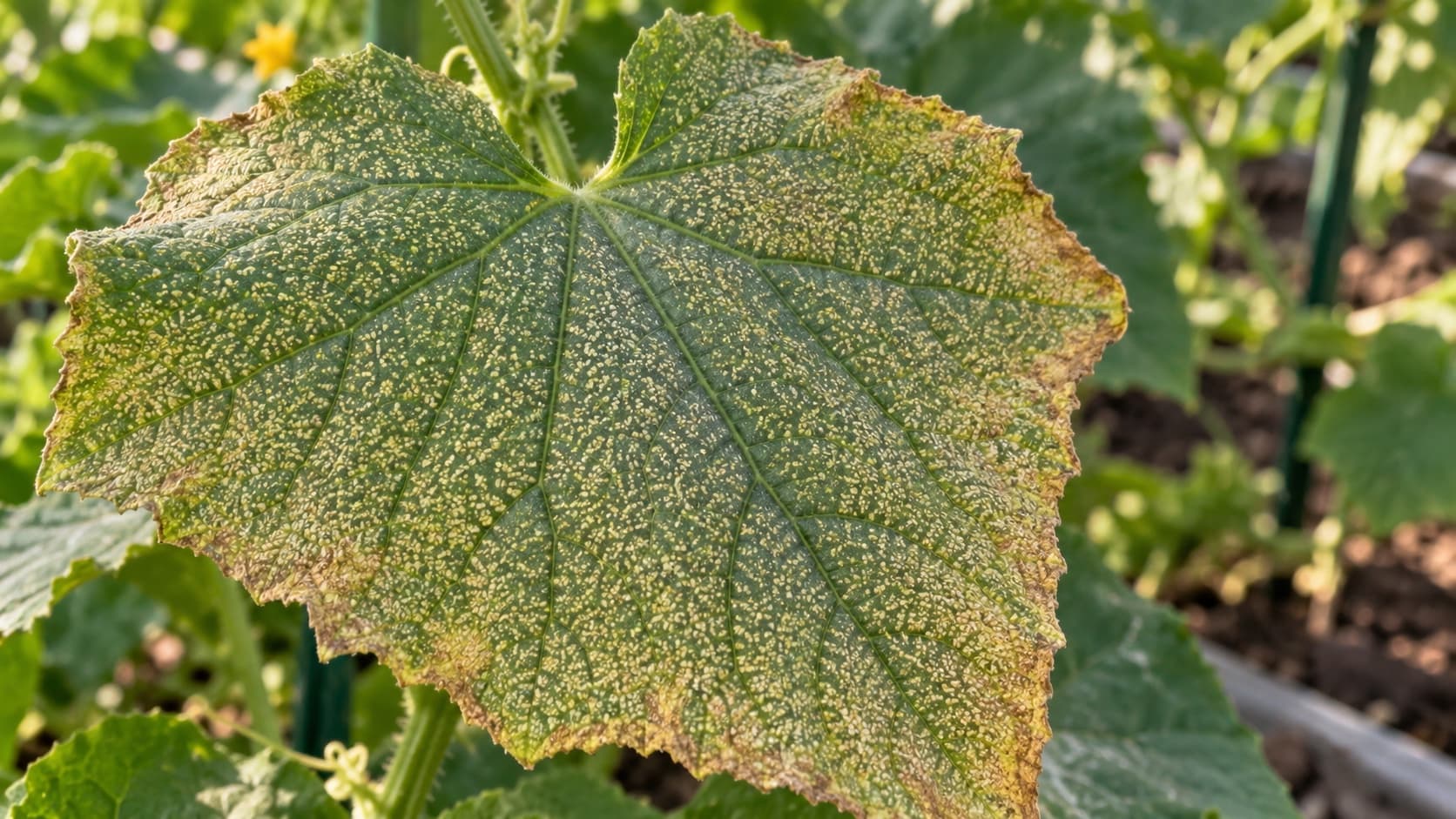
There is no version of this that starts with looking at the plant. The animal is a fraction of a millimetre across, it sits on the surface you are not looking at, and its colour is the colour of the leaf it is standing on. Every description of it is useless for the one thing you need, which is to know whether it is there. Knocking some of it onto white paper solves that in about a minute, because nothing else that falls off a leaf walks away.
- Step
Hold white paper under a leaf and tap the leaf
Adults are under 1/60 of an inch long
the adult body length, which is why the animal is routinely mistaken for a speck of soil — Iowa State University Extension
What to do
Plain paper, not a phone screen and not a notebook with lines on it. Slide it under a leaf low on the plant, then tap the top of that leaf several times with your free hand. Enough to shake it, not enough to break it.
What you see
Dust and a few specks land on the paper. Most of it stays exactly where it falls. What you are watching for is the specks that start walking after a few seconds, and there is no mistaking them once one moves.
- Step
Start at the bottom of the plant and work up
Feeding starts at the bottom of the plant and moves up as the plant declines
the direction the colony travels through the canopy, which is why the bottom leaves are always the ones that look worst — Iowa State University Extension
What to do
Test a leaf from the lowest third of the plant, then one from the middle, then one from the growing tip. Three leaves from three heights takes less time than reading this sentence twice.
What you see
If the bottom leaf gives you walking specks and the top one does not, you have caught it early and the colony is still where it started. If all three are clean, the plant is not the problem and you should be looking at the soil instead.
- Step
Turn the damaged leaf over
A single colony holds hundreds of individuals
what is on the back of one damaged leaf, which is why the underside is the surface that matters — UC Statewide IPM Program
What to do
Pick the leaf with the most speckling and look at its back, along the veins and into the corners where the leaf meets the stalk.
What you see
The underside of a leaf that has been fed on looks tan or yellow rather than green, and it feels gritty under a thumb. If there is a faint silk over it, the colony has been there long enough to be worth counting rather than guessing at.
- Step
Count what you found before deciding anything
Five mites per leaflet, counted with a 20x lens
the action level published for strawberry, the one count a home grower can take on a single leaf — Embrapa Uva e Vinho
What to do
Hold the paper flat in the shade and count the specks that are moving. A hand lens makes the count easier and is what the published threshold assumes, but the number is readable without one once the paper is still.
What you see
Five or more moving specks from a single leaflet is the published action level, and it is the closest thing to a garden threshold that exists for this pest. Under it, the colony is small enough that water and the predators already in the garden can hold it. Over it, the plant is losing leaf faster than it can replace it.
What the result means
Disturbed mites walk; nothing else that falls off a leaf does
how the animal behaves once it is off the plant, and the single difference the test rests on — UC Statewide IPM Program
The test works because the animal has to keep feeding, so it has to keep walking to the next cell. Once it is off the leaf and on paper that is warm from your hand, it moves, and it moves in a way that soil, compost, pollen and the shed skins of other insects never do. That is the whole reading: you are not identifying a species and you do not need to. You are separating a speck that walks from a speck that does not, and a walking speck on paper held under a garden leaf is this pest. The reason this matters more than a description is that the animal is nearly impossible to find on the plant even when you know it is there, so a reader who goes looking will usually conclude there is nothing wrong and water the plant instead.
What this test cannot tell you
The test tells you whether mites are on the leaf you tested, and how many. It does not tell you how many are on the plant, and one clean leaf does not clear the plant. A colony that started at the bottom of a tomato will not be on the leaf you happened to pick, so one clean leaf means one clean leaf; three leaves from three heights is where the answer starts being worth trusting. It also will not tell you which spider mite it is. Twospotted, Pacific, strawberry and several others cannot be separated in the field without a lens, and there is no reason to try, because their damage, their biology and the way they are managed are the same. What the test is genuinely good at is the decision in front of you: whether the plant's problem is something that walks, or something you have been watering.
What the plant looks like instead, and the one observation that separates them
Speckling, bronzed leaves, scorched edges and a plant that has stopped growing are what heat, dry soil and hunger look like as well, and the hot dry weeks that produce this pest are the weeks that produce all three. Each reading below is reasonable; each one costs a different amount of time.
Almost nobody arrives searching for a mite. They arrive with a plant that looks scorched, or dull, or hungry, and they have usually already decided which of those it is. That is not carelessness: fine pale speckling, bronzed leaves, brown edges and a plant that has stopped growing are what heat, dry soil and a shortage of nutrients look like as well, and the hot dry weeks that produce this pest are exactly the weeks that produce all three at once. So the first thing worth settling is not what the pest is but which of the explanations you already have is the right one.
A spider has spun a web on it
What that looks like
The name sends people looking for a cobweb, and on a plant with real webbing that is a fair reading of what is in front of them. It is also the reading that stops the search, because a gardener who has decided a spider is involved looks at the plant for a spider, does not find one, and concludes there is nothing there.
What settles it
The silk comes from the pest, not from a spider, and it is the last thing the colony does rather than the first. If there is webbing, look at what is under it: the animal is on the leaf, and the paper test above will find it in seconds.
Webbing appears only at high populations, after prolonged feeding
where webbing sits in the sequence of damage, which is why a web is the worst possible first sign — Iowa State University Extension
What acting on it costsThe most expensive misreading on the list, and the only one that costs the whole crop. Webbing means the colony has already been feeding long enough to cover the plant, and a reader who spends that week looking for a spider has spent the last week in which a water spray would have helped.
The heat has scorched the leaves
What that looks like
Hot weather and strong sun do burn foliage, and they burn the leaves that face it: the damage is on the top and the outer edge of the canopy, it appears in patches where the sun landed, and the leaf edge goes crisp and brown while the tissue around it stays green.
What settles it
This pest does the opposite. The speckling appears on the lowest and most shaded leaves first and moves upward, it is spread evenly across the whole surface between the veins rather than sitting at the edges, and the leaf does not go crisp. Tap the worst leaf over white paper and the difference is settled in a minute.
Damage begins in the lower canopy and progresses upward
the direction the injury travels through the plant, against the direction sun scorch appears in — University of Minnesota Extension
What acting on it costsA week, and the week is the expensive part. The population doubles in days rather than weeks, so a week spent moving shade cloth is a week spent on a plant that needed hosing down.
The plant needs water
What that looks like
This is the most reasonable reading of the three, and it is close to right. A water-stressed plant is exactly where this pest does worst, drought is what breaks the balance that normally holds the population down, and the lower leaves yellowing is a real sign of a plant short of water.
What settles it
Water the plant and look at it the next morning. A plant that was short of water stands up overnight and its lower leaves stop yellowing; the speckling stays exactly where it was, because the cells that were emptied are not refilled. Check the soil at a hand's depth as well - if it is damp and the plant still looks like this, water was never the answer.
Adequate irrigation is important because water-stressed plants are the most likely to be damaged
the relationship between water stress and the damage, which is why the watering instinct is half right — UC Statewide IPM Program
What acting on it costsA week, and a week of watering is not wasted on the plant even when it does nothing to the pest. What it costs is the delay: a week spent waiting for the leaves to green up is another seven days at doubling speed for the colony.
It needs feeding
What that looks like
A plant that has stopped growing and gone a dull yellow-green reads as hungry, and a shortage of nitrogen does produce pale leaves and slow growth. It also produces an even paleness across the whole leaf, on both sides of the midrib, starting with the oldest leaves and moving outward.
What settles it
Hunger is even and this is not. Look at a single leaf: the yellowing here is a speckle, and between the specks there is green tissue and a network of veins that are still the colour they were. On a plant that is merely hungry the veins are the greenest thing on the leaf; on this one they are part of the same speckled surface.
Feeding removes the contents of individual leaf cells
what the injury does at the scale of one leaf, which is why the speckling is mottled rather than even — University of Minnesota Extension
What acting on it costsA feed bought and an afternoon spent applying it, which is the cheapest of these mistakes. The cost that matters is the same as the others: a plant given nitrogen in a hot dry week is a plant the colony can feed on faster, because the new growth it pushes out is exactly what this pest prefers.
It is the end of the season
What that looks like
Crops do finish. A tomato in September goes yellow from the bottom up, drops its lower leaves and puts what it has left into the fruit, and none of that is a problem to be solved.
What settles it
Senescence is even and unhurried and it comes with the fruit. This is patchy, it arrives in the space of a fortnight rather than a month, and the leaves drop while the fruit is still filling rather than after it has ripened. The paper test separates the two in the time it takes to hold a leaf.
In hot dry weather the pest can strip a plant of its leaves in a few weeks
how fast a heavy infestation defoliates a plant, against the month a crop takes to finish naturally — University of Kentucky Entomology
What acting on it costsThe crop. This is the reading that does nothing at all, and it is the one a reader reaches for in the exact week the damage is still recoverable, because the plant looks the way plants are supposed to look at the end of a season.
Every reading above is reasonable, and that is the point: the plant's appearance genuinely does not distinguish them. Only one of them can be settled from the plant alone, and it is settled by a walk to the kitchen for a sheet of paper rather than by a closer look. What the test cannot do is tell you how much of the plant is already gone, which is the next question.
If the damage is distortion rather than speckling, it is a different animal
The relatives that share a garden with this one do not all leave the same mark: some distort tissue instead of speckling it, and some bronze a stem instead of a leaf. None of them can be identified without a lens, so the rows separate them by where on the plant the damage appears.
Three of the mites a home grower meets do not speckle a leaf at all. They feed at the growing point, and what they leave behind is distortion rather than stippling: curled, hardened, strap-like leaves coming out of a bud that never opens properly. The distinction matters because the treatment is different and the animal is not the same one - a miticide that controls a spider mite is not necessarily effective against these, and every hour spent spraying the undersides of leaves is an hour spent on the wrong part of the plant.
Broad mite
Where it feeds
In and around the buds and the youngest leaves, not spread across the underside of a mature leaf. It is a tropical and subtropical species, and in cooler regions it arrives on plants bought in rather than overwintering outdoors.
Adult females are about 0.2 mm long, and the eggs have rows of raised white bumps
the body length and the egg surface, which is the one feature that can be checked with a 20x lens rather than a microscope — University of Florida IFAS St. Lucie County
What it leaves behind
The leaves coming out of the growing point are twisted, hardened and puckered along the edges, and the outer edges turn downward rather than upward. It injects a toxin as it feeds, which is why the damage keeps getting worse after the mites are gone and why it looks like herbicide drift, a boron or calcium shortage, or cold injury.
What this changesA plant whose growing point is distorted is being damaged by something a water spray does not reach, and the miticide shelf is not interchangeable either: the products that control a spider mite are not necessarily effective against this one. Take a distorted growing tip to an extension office rather than spraying the leaves.
Cyclamen mite
Where it feeds
Along the midvein of young leaves that have not unfolded yet, and under the calyx of newly formed flower buds - which is to say, inside the crown of the plant, where nothing you spray lands unless it soaks in.
Mature mites are about 0.25 mm long, and one female lays about 90 eggs
the body length and the reproductive rate, which together explain how fast a crown is colonised — UC Statewide IPM Program
What it leaves behind
The leaves in the centre of the plant become severely stunted and crinkled and pack into a compact mass, the flowers wither, and any fruit that sets is dwarfed. On a strawberry the seeds stand out on the flesh of the berry. It is the mite that turns the middle of a plant into a knot.
What this changesThe folded leaves inside the crown are the target, and a contact spray that wets the outside of the plant reaches almost none of it. Control requires soaking the crown, and on a plant already badly infested the practical answer is often to remove it rather than treat it.
Tomato russet mite
Where it feeds
On the stems and the fruit as well as the leaves, starting near the ground and moving up - which is the opposite of a leaf-surface pest that begins at the bottom and stays on the foliage.
A 14x hand lens is needed to see them, and they are rarely noticed until the plant is damaged
the magnification required and the reason the damage is the first thing anyone sees — UC Statewide IPM Program
What it leaves behind
The stems and leaves take on a greasy bronze or russet colour rather than a speckled pale one, the lower leaves dry out, and the fruit itself is scarred and russeted. It is a tomato and nightshade pest, and the bronzing on the stem is the part that separates it on sight from a spider mite.
What this changesBecause it feeds on the stems and the fruit, washing the undersides of leaves misses most of it. Sulfur is the material the published guidance puts first, and it also has to be applied where the mites actually are, which means the stems.
The predatory mites that are eating this one
Where it feeds
On the same leaves, in the same colonies, at the same time - a predator is about the size of the pest but has longer legs and moves faster, and it is teardrop-shaped rather than oval.
One predator for every ten pests is the ratio that provides control
the ratio the biological control rests on, and the reason a spray that removes predators hands the plant to the pest — UC Statewide IPM Program
What it leaves behind
None. These are the reason an outbreak sometimes ends by itself, and the reason a broad-spectrum spray makes the problem worse. A colony that is collapsing has more predators in it than pests, and the paper test is what tells the two apart: the pest's specks walk steadily, while a predator crosses the paper faster and in a straighter line.
What this changesSpraying a plant that already has predators on it removes the thing that was working, and the population that follows is larger than the one that was there. Test the paper before treating, and check whether the specks are walking or hurrying.
Each row is a different problem, and only the last of them is good news. What separates them is not the animal - most of these cannot be seen without a lens at all - but where on the plant the damage appears: speckling spread across a leaf is the spider mite, and distortion at a growing point, a knotted crown or bronzing on a stem is one of its relatives. That single observation is worth more than any description of the animals themselves, because it is the one a reader can make standing in the garden.
From a speckle to a web, and what the plant can still do at each stage
The damage runs one way and it does not turn around. The web is the stage everybody recognises and it is the last one, so read the ladder from the top: the rungs that decide the crop are the early ones, and by the time the silk arrives the decision has already been made.
The damage runs in one direction and it does not turn around. Each rung below is a stage the leaf has already reached, and the useful thing about reading them in order is that the last one is the one everybody knows: the rungs that matter are the early ones. A leaf that is speckled is still feeding the plant; a leaf that has been covered in silk has stopped, and the silk is the signal that arrives after the decision has been made.
Pale speckling
The first visible symptom, and it appears before the plant looks wrong overall
where stippling sits in the sequence, stated as the earliest sign the injury is present — Clemson University HGIC
What you see
The top of the leaf is covered in tiny pale dots, close enough together on the worst leaves to read as a lighter shade of green rather than as marks. The dots are the empty cells: the animal has fed on the contents of each one and left the wall behind, which is why the speckle is the colour of an empty cell rather than the colour of a dying one.
What the leaf is still doing
The leaf is still working. It has lost some of the tissue that makes sugar and it is still paying for itself, and this is the stage where the plant's own growth is faster than the colony's damage. Nothing has to be removed and nothing is beyond saving.
What to do at this stage
Hose the undersides down and keep checking. This is the rung where a water spray is worth an afternoon, because the population is small enough that knocking it off the leaf matters more than anything you could buy.
Dulled, bronzed colour
Stippling progresses to an overall bronzing of the leaves
the change from speckled to bronzed, which is the point the leaf stops looking merely marked — Virginia Tech Department of Entomology, Spider Mites (ENTO-502)
What you see
The speckling has closed up. The leaf has gone from green with pale dots to a dull bronze or grey-green overall, the underside has turned tan, and the leaf has lost the shine it had. The tissue is not dead and it is not dry; it has simply run out of the cells that were doing the work.
What the leaf is still doing
The leaf is running a deficit. It is still respiring and still losing water through the surface the animal opened up, and it is making less sugar than it costs to keep. It will not go back to green, whatever is done to it.
What to do at this stage
Leave it on the plant and protect what is above it. A bronzed leaf is still shading the fruit and still moving water, so cutting it off removes more than it saves - the exception is a leaf that has gone brown and crisp, which is no longer doing anything.
Leaves yellow, then brown, then drop
Prolonged feeding turns leaves completely yellow, then brown, and they fall
what happens to a leaf that has been fed on long enough, in order — Iowa State University Extension
What you see
The whole leaf has gone, not just the surface. It yellows, then browns from the edges in, and it drops - and it drops while the fruit is still filling rather than after the fruit has finished, which is what separates this from a crop coming to its natural end.
What the leaf is still doing
Finished. The leaf is a net loss to the plant, and its fall takes the canopy with it: the fruit underneath it is suddenly in full sun, and on a squash, a melon or a watermelon that means sunscald on the fruit itself.
What to do at this stage
Sweep up what has fallen and keep the middle of the plant covered. Once leaves are dropping, the work changes from treating the pest to protecting the fruit, and on a vining crop that may mean putting something over the fruit that has lost its shade.
Fine webbing over the leaves and stems
Webbing appears on the edges and undersides of leaves at high populations
the population level at which silk shows up, which is what makes it a late sign rather than a warning — Iowa State University Extension
What you see
There is silk on the plant, and it is not a cobweb: it runs along the edges of the leaves, gathers where the leaf meets the stem, and holds specks of dust and shed skins. The animal is still on the leaf underneath it, in numbers, and the whole colony is now visible at once.
What the leaf is still doing
The colony is at its peak and the plant is near the end of what it can lose. Silk does not appear while a population is being held down by anything, so webbing also tells you that whatever was eating the pest has already gone.
What to do at this stage
Decide whether the plant still has anything worth finishing, and then act on that answer rather than on the plant's appearance. A vining crop with green leaves above the webbing can still ripen what it has set; a plant with webbing to the growing tip has nothing left to fill fruit with, and water is better spent elsewhere.
A 10 to 15 percent loss of effective leaf area
What the plant loses when the lower leaves go early
the point at which the loss of leaf surface justifies treating a crop at all — University of Minnesota Extension
That figure is the one to hold on to, because it reframes what the damage is. The leaves are not decoration and they are not the crop: they are the factory that fills the fruit, and what a reader has lost is a fraction of the factory rather than a fraction of the harvest. A plant that has lost the bottom of its canopy still has the middle and the top, and the fruit those leaves are feeding will fill normally. A plant that has lost the middle has nothing left to fill anything with, and its fruit will be small, slow to ripen and prone to sunscald where the shade used to be. The practical consequence is that the two decisions - nurse it or pull it - are rarely close. Look at the growing tip. If it is still extending and the new leaves are coming out full-sized, the plant is outgrowing the damage and it finishes. If the silk reaches the tip and the newest leaves are already stunted, the season for that plant is over and the useful thing to do is to stop watering it. And the loss is permanent in a way that is easy to underestimate: the damage is not reversible, so a leaf that has bronzed will not green up again no matter what is sprayed on it, and every week of delay is another week of leaf area that does not come back.
What to watch for in the forecast, rather than in the wreckage
This pest has no season and no planting date. It has a week - a combination of heat and dry air that gives it an advantage nothing in the garden can match - and the same combination is in a weather app about a week before it is in the leaves.
This is not a pest that arrives on a date. It arrives on a week - a specific combination of heat and dry air that gives it an advantage nothing in the garden can match - and the reason that is useful is that the same combination is in the forecast before it is in the leaves. Recognising the week is how a reader catches the colony while the first rung of the damage is the only rung.
A hot, dry stretch
Above 85°F with humidity under 90 percent and little moisture
Above 29°C with humidity under 90 percent
the combination the population increases in, stated as the condition rather than as a season — Iowa State University Extension
What it does to the population
This is the trigger, and it is a combination rather than a temperature. Heat alone does not do it: the animal needs the air to be dry at the same time, which is why an ordinary hot summer is a nuisance and a hot drought is an outbreak. Dry air also speeds up its development and raises the number of eggs it lays, so the same week that is hard on the plant is generous to the pest.
What to look at
Watch for a run of days in the mid-eighties or above with low humidity and no rain in the forecast. That is the week to start testing leaves, and it is the week before anything shows on the plant.
Warm nights
40 days from egg to adult at 54°F, 14 days at 70°F, and 7 days at 86°F
40 days at 12°C, 14 days at 21°C, 7 days at 30°C
the development time from egg to adult at three temperatures, which is the whole reason the week matters — UCONN Extension
What it does to the population
The speed of the animal's life is set by temperature and nothing else, and the change is not gradual. A fortnight of mild weather is a fortnight for one generation; the same fortnight at 86°F is two, and each generation is a multiplication rather than an addition. Warm nights matter as much as warm days, because the development does not stop after dark.
What to look at
Look at the overnight lows, not the daytime highs. A week of nights that stay above about 68°F is a week in which the population is running at close to its fastest.
A dry month, whatever the week is doing
Populations can rise to 70 times their number in six to 10 days
70 times in six to 10 days
the multiplication a population is capable of once conditions suit it, which is why a month of drought matters more than a hot week — University of Minnesota Extension
What it does to the population
Drought does three things at once and they compound. It dries the air and the leaf surface, it makes the plant itself a better host because a water-stressed plant is a more concentrated food source, and it stops the fungus that normally ends these outbreaks, because that fungus needs a long humid spell to infect anything. A dry month is therefore the setup and the hot week is only the trigger.
What to look at
If the ground has been dry for weeks and the forecast turns hot, the colony has a head start you cannot see yet. This is the week to test the lower leaves rather than the week to wait for the plant to look wrong.
Dust and bare, dry ground
Dusty conditions frequently lead to outbreaks
the link between dust and the populations, which is why path edges and bare soil are where the damage starts — UC Statewide IPM Program
What it does to the population
Dust does two things that suit the pest: it dries the leaf surface further, and it clogs and abrades the small predators that would otherwise be eating it. Gardens next to a road, a gravel path, an unmulched bed or a building site are the ones that get it first, and the pattern shows up as damage at the bed's edge rather than in its middle.
What to look at
Look at your own ground rather than at the sky. If a path runs along the bed, or the soil between the plants is bare and dry, the next hot week will start the colony on that side.
A wet, humid spell
A fungal disease of the pest performs best below 85°F with humidity above 90 percent for 12 hours
Below 29°C with humidity above 90 percent
the conditions that let the natural fungus take the population down, which is the one forecast in the pest's favour — Iowa State University Extension
What it does to the population
This is the good news and it is worth knowing, because it explains something that otherwise looks like a mystery: an outbreak that ends by itself. There is a fungus that attacks this animal and it is present in most gardens most of the time, held back by dry air. A run of cool, humid nights lets it spread through a colony, and an infected mite turns brown and stops moving.
What to look at
A humid week with mild nights is the week to test again before spending anything. If the specks on the paper are brown and still, the population is already coming down and the plant will often recover on its own.
Read the bands together and the season makes sense. A dry month sets it up, a hot week triggers it, dust concentrates it, and a cool humid spell ends it. None of that is under a gardener's control, and that is not the point of the block: the point is that almost all of it is visible in a forecast a week before the leaves show anything, and the band in the pest's favour is a reason to test again before buying a spray.
What each option removes, and what it leaves behind
The products that kill the widest range of insects are the ones most likely to make this problem worse, because the pest is not an insect and the things eating the pest are. Read the second column before the first.
Most of what is sold for this pest is not sold for this pest. You arrive at a shelf looking for something that kills the thing on the plant, and the products that kill the widest range of insects are the ones most likely to make this particular problem worse, because this animal is not an insect and the things that eat it are. Read the second column before the first: the question is not what a spray removes, it is what it leaves behind.
What it removes
What it leaves
Water, sprayed hard at the undersides
Regular forceful spraying with water often reduces numbers adequately in a garden
the finding that puts a free option ahead of a purchase, and the note that it stops working on high populations — UC Statewide IPM Program
What it removes
Mites, physically. A forceful spray knocks them off the leaf and they do not climb back quickly, and it also washes off the dust and the silk that were helping them.
What it leaves
The ones that were not hit, and the eggs, which are stuck to the leaf and largely unaffected by water. This is why it has to be repeated: a single spray lowers the population and does not end it.
This is the step to take before buying anything, and it is the one least likely to be tried because it does not come in a bottle. Get the water to the underside of the leaves, which means holding the leaf up or spraying from below rather than raining on the plant from above, and do it in the morning so the foliage dries. It is not a cure and it is not permanent, and on a plant with webbing to the growing tip it will not be enough.
An insecticidal soap
Soaps and oils have no residual activity, so only what is directly hit is harmed
why a contact spray is the gentler option for the things eating the pest, and why it needs repeating — Clemson University HGIC
What it removes
Mites that the spray actually touches. Soap strips the waxy layer off the animal's body and it dies where it is standing, which makes coverage the whole of the technique.
What it leaves
Everything the spray did not touch, because soap has no residual activity at all. That is also what makes it a good first choice: only what was hit is affected, so a predator you missed is a predator that lives.
The two rules are coverage and temperature. The underside of every leaf has to be wet, which on a vining crop is a job in itself. And it must not be used on a water-stressed plant or above 90°F, because a soap spray under those conditions damages the leaf it was meant to protect. Test it on one or two leaves the day before, since some plants react badly.
A horticultural or plant-based oil
Oils must contact the mites to kill them, so thorough coverage of the undersides is essential
the coverage requirement stated as the condition for the product to work at all — UC Statewide IPM Program
What it removes
Mites by suffocation rather than by poison, which is why resistance is not the problem it is with the stronger products. It also smothers eggs that are coated with it.
What it leaves
Everything it did not reach, for the same reason as soap. And the oil is not selective: a predatory mite or a lacewing larva that is sprayed is as dead as the pest.
Oils are the better choice of the two contact sprays on a hot week, because they are less likely to burn than soap and they leave no residue behind for the plant to react to. The temperature rules still apply, and there is one more to add: oil and sulfur must not be used within a month of each other, in either order.
A miticide labelled for mites
Insecticides do not kill the eggs, so a treated plant should be checked 7 to 10 days later
the re-scouting interval that follows any spray, which is the instruction the labels carry and the one that gets skipped — Iowa State University Extension
What it removes
The adults and the immature stages, and it does it more thoroughly than anything a garden centre sells for insects, because it was developed for this animal specifically.
What it leaves
The eggs. No product on this list kills them, so the population starts rebuilding within days of the spray and the treated plant has to be tested again about a week later rather than assumed to be finished.
This is the option for a plant with a crop on it and a population that water has not held, and it is worth being precise about what it buys: a week. Because it does not touch the eggs, the second generation is already on the leaf when the first one dies, and a reader who sprays once and stops has paid for a fortnight of relief. Rotate what is used between applications, because this animal develops resistance to miticides faster than almost anything else in a garden.
A broad-spectrum insecticide for something else
Broad-spectrum sprays remove the natural enemies that prevent the pest from resurging
the finding that pyrethroids and similar products make the problem worse, stated as a recommendation against using them — Iowa State University Extension
What it removes
The pest, along with every predatory mite, predatory thrips, lacewing larva and small beetle that was eating the pest, and in some cases it also stimulates the survivors to breed faster.
What it leaves
The population, in the sense that it comes back higher than it started. This is the counterintuitive part and it is well documented rather than theoretical: the outbreak that follows a spray is often worse than the one it was meant to end.
The mechanism is not subtle. The pest is a mite, not an insect, so insect killers are the wrong tool, and the things that were holding it down are insects, so they are exactly the right victims. Add the fact that some of these products appear to raise the nitrogen in the leaves, which makes the plant better food, and the result is a population explosion on a plant that was sprayed to protect it. The rule that follows is worth applying to the whole garden: never spray broadly for another pest in a hot, dry week, because that is the week the predators are the only thing standing between a few mites and all of them.
Sulfur
Do not use sulfur above 90°F, or within 30 days of an oil spray
the two temperature and timing limits printed with the product, which between them rule it out of most hot weeks — UC Statewide IPM Program
What it removes
Mites on contact, and it is one of the few materials that works on both this pest and the powdery mildews that often arrive in the same conditions.
What it leaves
A plant that may be burned by it. Sulfur damages some crops outright, and cucurbits are the ones most often named, so it is not a spray to try for the first time on a plant you need.
Sulfur has a real place in a garden and this is rarely it. The conditions that produce a mite outbreak - heat above 85°F and dry air - are the conditions in which sulfur burns foliage, and the second rule closes off combining it with the oil that would otherwise be the safer choice. Where it does fit is a cool, humid spell on a crop known to tolerate it, which is a narrow window and one worth taking only if the plant in question is not the only one you have.
Every row above is a question about the future rather than about the plant in front of you, and that is the trap this block exists to name. A spray that kills the mites on a bronzed leaf has killed the pest on a leaf that has already stopped paying for itself, while removing the predators that were working on the leaves above it. That is why the order of the work matters more than the choice of product: water, coverage and a fortnight of testing will do more than the strongest bottle on the shelf, and the strongest bottle used alone will leave the plant worse off than the weather did. It is also why the honest answer for a plant that is already covered in silk is often that there is nothing worth spraying, and the water is better spent on the plant beside it.
What to do at the stage your plant is actually in
Each step names the stage it belongs to, because the mistake this pest punishes hardest is using the late answer early: a miticide sprayed on a plant at the first sign has removed the predators from a plant that did not need it.
The list is ordered by what a plant can still be saved with rather than by how much each step matters, so the free steps come first and the ones that are only possible before the damage starts come last. Each step names the stage it belongs to, because the mistake this pest punishes hardest is using the late answer early: a miticide sprayed on a plant at the first rung has removed the predators from a plant that did not need it.
One predator is needed for every ten mites to provide control
the ratio the biological control rests on, which is why a spray that removes predators hands the plant to the pest — UC Statewide IPM Program
- Stage
While the speckling is the only sign
Hose the undersides down
CostTwenty minutes and a hose
Hold the leaf up, or spray from underneath, so the water reaches the surface the animal is actually on. Raining on the plant from above rinses the top of the leaves and leaves the colony untouched, which is the single most common reason this step is reported as not working. Do it in the morning so the foliage dries before evening, and do it again in a few days, because a single pass lowers the population rather than ending it.
- Stage
Before the next hot, dry week
Water and mulch the ground
CostA bag of mulch and a different watering habit
The plant's own water status is part of the pest's advantage: a plant short of water is a better host and a worse competitor, and dry bare soil both dries the air at the leaf surface and gives the animal a dust-free route up the stem. Water deeply rather than often, and cover the soil between the plants. This is the step that pays off before anything is visible, which is why it sits above the ones that only help after the damage has started.
- Stage
Once the colour has gone
Leave the bronzed leaves on the plant
CostNothing, and it saves work
This is the step that contradicts the instinct to tidy up. A leaf that has bronzed is still shading the fruit and still moving water, and the animal has already finished with it and moved on, so cutting it off removes a leaf that was still doing some work and gains nothing. Take off only what has gone brown and crisp, or what has fallen. The exception is a leaf that is feeding a colony, which is worth removing and binning - but check the underside before deciding, because the worst-looking leaf is often the one they have left.
- Stage
Any stage
Stop spraying for anything else
CostRestraint, and a pest you tolerate
Whatever else is on the plant this week, a broad-spectrum spray will take the predators with it and the population that follows will be larger than the one you had. This matters most in exactly the weather that produced the mites, because it is the week the predators are doing the most work. If something else genuinely needs treating, spot-treat that plant and leave the rest of the bed alone.
- Stage
The week after you act
Test the plant again in three days
CostA minute a plant
Nothing on this list kills the eggs, so every treatment above is a setback for the population rather than an ending, and the animal's generation time in hot weather is under a fortnight. Test the same leaves again three or four days later. If the specks on the paper are brown and still, the natural fungus has arrived and the population is going down on its own; if they are still walking, the population is rebuilding and the answer is the next step rather than the same one again.
- Stage
After the crop, before next summer
Clear the weeds and settle the dust
CostAn afternoon in autumn and a watering can in July
The animal overwinters as an adult in sheltered ground and on the permanent plants around the bed, and it moves back onto the crop when the weather suits it - from the weeds, the hedge, the grass verge and the dry soil at the edge of a path. Clearing the rank weeds near the bed and keeping the paths and the bare ground damp lowers the number that starts next year. It is the least urgent step on the list and the only one that changes the following season rather than this one, which is why it sits at the bottom of a list ordered by urgency.
Hosing the plant down and watering the ground cost an afternoon between them, and they are the two that change what happens to this plant. Everything below them is either a holding action or a change to next year. The step that is missing from the list is deliberate: there is no recommendation to remove the damaged leaves, because a bronzed leaf is still working for the fruit above it and the animal has usually left it. Work down the list and stop when the paper comes up clean.
Why the damage looks like the weather, and why the animal is on the underside
The mechanism behind the page: what the animal does to a leaf cell, why drought is one of the causes rather than a coincidence, and what actually ends an outbreak.
Why the damage looks like the weather
The reason this pest is so often missed is not that it is well hidden. It is that the damage it does and the damage a hot dry week does are the same damage, and they arrive in the same week. When a plant is short of water it closes the pores in its leaves to stop losing more, which slows the movement of water up the stem and the transport of sugar back down, and the leaves that suffer first are the oldest ones at the bottom of the canopy. When this animal feeds, it empties the contents of individual cells, and the leaves that suffer first are also the oldest ones at the bottom of the canopy. Both produce a plant whose lower leaves are pale, whose growth has slowed, and whose new leaves are smaller than they should be.
There is a reason the two are correlated rather than merely similar, and it is the part that matters. Drought is not just a coincidence of the season: it is one of the things that causes the outbreak. Dry air speeds the animal's development and increases the number of eggs it lays. A water-stressed plant is a more concentrated food source and a worse defender. And the long humid spells that let the fungus attack the population are exactly what a drought removes. So the hot, dry week produces both the stress on the plant and the pest that damages it, and the gardener who diagnoses the first and waters the plant has addressed half of a two-part problem.
That is also why the misdiagnosis is not a failure of attention. A reader who waters a plant with mites is doing something genuinely useful for that plant, and the mistake is one of completeness rather than of kind: the plant needed water, and it also needed the animal on its leaves dealt with. What the two weeks of watering costs is not the water. It is the fortnight the population spent doubling, on a plant that was already losing leaf area it will never get back.
- The leaf damage is genuinely the same as drought damage, and it appears on the same leaves at the same end of the plant.
- Drought does not merely resemble the cause, it is one of the causes: dry air suits the pest and stops the fungus that would end the outbreak.
- Watering a plant with mites is not wrong, it is incomplete - and the cost of the delay is measured in leaf area that does not come back.
Why the animal is on the underside
Every part of the animal's behaviour points at the same surface, and the reason is water. The underside of a leaf is the most humid place on the plant: it is out of the sun, the air moves less across it, and the pores that release water vapour are concentrated on that side, so the layer of air sitting against it is wetter than the air on the top. For an animal a fraction of a millimetre across, that layer is the environment it lives in, and its whole life is arranged around staying in it.
So the eggs are laid along the veins on the underside, often under a layer of silk that holds them in place. The cast skins and the empty shells stay there, which is what makes the underside of a damaged leaf look tan and feel gritty rather than merely pale. And the animal feeds there, driving a mouthpart into the cells it reaches from below, which is why the damage shows up on the top surface as a speckle even though nothing has ever touched the top surface. The mark and the animal are on opposite sides of the leaf, and that single fact is the reason the paper test exists: reading the top of the leaf can tell you that something is wrong, and only the bottom can tell you what.
It also explains the direction the damage travels. The underside of a leaf low in the canopy is more humid than the underside of a leaf at the growing tip, because it is more shaded, the air around it moves less, and it is closer to the soil. So a colony establishes at the bottom of the plant, and it moves upward as it uses up what is there and the canopy above it thins out and loses the humidity that was holding it. A reader who checks the newest growth first, which is the instinct, will look at the one part of the plant the colony has not reached yet.
Why it explodes in a hot week
The arithmetic of this animal is the reason a week matters. An adult female lives about a month and lays up to 200 eggs in a fortnight, and the time from egg to adult is set almost entirely by temperature: 40 days at 54°F, 14 days at 70°F, and seven days at 86°F. The population can rise to 70 times its number in six to 10 days. Those are not three separate facts; they are one fact about a life cycle that shortens as the temperature rises while the number of eggs laid per female stays the same.
Two things follow that a gardener can use. The first is that the population you can see is not the population you have: because every female produces more than one replacement, the count on the leaf today is a generation behind what is already on the plant, and the eggs on that leaf are invisible. The second is that the eggs are the reason a single treatment rarely ends anything. Every method that works on the adults leaves the eggs, so the population rebuilds from the leaf surface within days, which is why the extension services that publish a re-scouting interval put it at 7 to 10 days rather than at the end of the season.
Two of those figures are stated differently by different services, and the spread is worth knowing about rather than smoothing over. The development times above are UCONN's, measured at three set temperatures; Minnesota publishes five to 19 days for the same animal depending on temperature and host, which is a wider band for the same range. The egg count runs the other way: Kentucky publishes up to 200 eggs from one female, Minnesota about 100. The disagreement does not change the argument - every published band is short enough that a hot week is two generations - but a reader who checks two sources should find that the page expected them to.
The heat is also why the problem is worse in a garden than the field guides suggest. The published figures for yield loss come from field crops, where a drought that triggers the pest also dries the canopy out and slows it down again. In a garden the plants are watered, the canopy is dense, and the soil under them is mulched, so the population gets the heat without the counterweight - and the same watering that keeps the plant alive keeps the underside of its leaves humid enough for the colony to keep feeding.
What ends an outbreak
Outbreaks end on their own more often than they are ended, and the reason is worth knowing because it is the difference between spending money and waiting. The animal has a large set of natural enemies - predatory mites, predatory thrips, lacewing larvae, minute pirate bugs, and small beetles that feed on nothing else - and they are present in most gardens most of the time, at low numbers, held back by the same dry air that suits the pest. Once the pest's numbers rise, the predators have food, and their populations follow with a lag.
There is also a disease on the pest's side of the ledger. A fungus attacks these mites and it needs the opposite conditions from the ones that caused the outbreak: it spreads in cool, humid weather, and it needs humidity above 90 percent for about 12 hours to infect anything. An infected mite turns brown and stops moving, which makes the paper test diagnostic in a second way - brown specks that sit still are not a failing treatment, they are the fungus arriving. In most years that fungus is what keeps this from being a problem at all.
Which leaves a reader with a decision rather than a rule. Waiting for the predators and the fungus is the right answer on a plant that is still mostly green and on a week that is turning cool and humid, and it is the wrong answer on a plant whose growing tip is already webbed in a forecast of another hot, dry week. The two things worth doing either way cost nothing: keep the plant watered so it is not fighting two problems, and test it again in three days, because the direction the population is moving is the only fact that decides whether the next step is a hose or nothing at all.
- Predators follow the pest with a lag, so a population can collapse on its own a fortnight after it looks hopeless.
- A cool, humid spell lets a fungus attack the mites; brown specks that do not move on the paper are that fungus, not a treatment failure.
- Test again in three days before buying anything - the direction of the population decides the next step, not the state of the plant.
The diagnostic guidance draws on the references listed below.
- Clemson University HGIC: Integrated Pest Management (I.P.M.) for Spider Mites
- Iowa State University Extension: Twospotted Spider Mites
- UC Statewide IPM Program: Spider Mites (Pest Notes 7405)
- UCONN Extension: Greenhouse Pest Message, June 27 2024
- Virginia Tech Department of Entomology: Spider Mites (ENTO-502)
- UCONN Extension: Managing Broad Mites on Greenhouse Crops
- University of Florida IFAS St. Lucie County: Pepper Problem - Broad Mite
- UC Statewide IPM Program: Cyclamen Mite (Strawberry Pest Management Guidelines)
- UC Statewide IPM Program: Tomato Russet Mite (Tomato Pest Management Guidelines)
- University of Kentucky Veggie Scout: Broad Mite
- University of Kentucky Entomology: Two-Spotted Spider Mite (ENTFACT-310)
- Embrapa Uva e Vinho: Ácaro-rajado (Tetranychus urticae)
- University of Minnesota Extension (es): Manejo de la araña roja en la soja
- University of Minnesota Extension (es): Araña roja de dos manchas en la soja
Quick answers before you treat the plant
The questions that arrive with the search, answered without the spray the search results lead with.
What kills spider mites instantly?
Nothing does, and this is the question most likely to end in a product that makes the problem worse. A forceful water spray removes the ones it hits immediately and leaves the eggs; an insecticidal soap or a horticultural oil kills on contact and leaves everything it did not touch, which is why both need repeating. The strongest option - a miticide labelled for mites - kills the adults and the immatures and still leaves the eggs, so the plant has to be tested again about a week later. The reason to avoid the broad-spectrum insecticide on the same shelf is that it removes the predatory mites and thrips that were holding the population down, and the outbreak that follows is often larger than the one it was sprayed for.
Can a plant recover from spider mites?
The leaves do not, and the plant usually does. The animal feeds by emptying individual cells, and a cell that has been emptied does not refill, so a leaf that has gone speckled stays speckled and a leaf that has bronzed stays bronzed. What recovers is the plant's ability to finish its crop: as long as the growing tip is still extending and the new leaves are coming out full-sized, the middle and upper leaves are still filling the fruit, and a vining crop that has lost the bottom of its canopy can ripen what it has set. Look at the tip rather than at the damage, and stop watering a plant whose newest leaves are already stunted and webbed.
Does dish soap kill spider mites?
A soap spray does kill them on contact, and the product sold for the job is formulated to do it without damaging the plant. Washing-up liquid is not, and the difference matters here more than it does for most home remedies: it is a degreaser, it strips the waxy layer off a leaf the same way it strips grease off a plate, and on a plant that is already water-stressed or on a day above 90°F that damage shows up within a day. If soap is the plan, use the horticultural product, test it on two leaves first, and make sure it reaches the undersides, because a spray that only wets the top of the leaf has done nothing at all.
Where do spider mites come from every year?
From the ground and the plants around the bed, and from the wind. They overwinter as adult females in sheltered soil, under bark and in the litter at the base of permanent plants, and they move back onto a crop when the weather suits them - often walking a short distance from weeds or a hedge, and sometimes arriving on a silk thread carried by the wind. That is why the damage so often starts at the edge of a bed rather than in the middle, and why the plants next to a road, a gravel path or a patch of rank weeds are the first to show it. Cleaning up the weeds and the debris around the bed lowers the number that starts next year; it does not stop them arriving from somewhere else.
Should I cut off the damaged leaves?
Mostly no, and this is the one instruction that runs against the instinct to tidy up. A bronzed leaf is still shading the fruit underneath it and still moving water, and the animal that damaged it has usually already left for newer growth, so removing it takes away a leaf that was doing some work and gains nothing. Take off what has gone brown and crisp and what has already fallen. The exception is a leaf that is still carrying a colony, and the way to know is the paper test rather than the appearance - check the underside before deciding, because the worst-looking leaf is often not the one they are on.
Do spider mites survive winter in the soil?
The adult females do, and that is the stage that starts next year. As the weather turns they stop feeding, change from green to orange-red, and move into sheltered ground - soil cracks, the litter at the base of a hedge or a perennial, under the loose bark of a fence post or a tree - and they wait there until warm weather returns and a host plant is available. They do not need a crop to survive the winter and they do not all stay in your garden, so autumn cleanup lowers the local starting number rather than preventing the pest. It is worth the afternoon, and it is not worth relying on.
Keep troubleshooting from the right starting point
If this was not the exact symptom you meant, jump back to the hub or compare it with the other common problem guides.
All Garden Problems
Return to the main troubleshooting hub to compare the quick triage and all four featured problem guides.
Back to the hub
Topic
Vegetable Garden Basics
Beginner-friendly setup, layout, and planting-timing guides for growers building a practical home vegetable garden.
Tomato Leaf Curl: Physiological Roll vs Disease & Pests
How to tell harmless upward leaf curling caused by heat and wind from broad mites, herbicide drift, or viral infections.
Aphids on Plants: The Count That Says Whether to Act
How to confirm it is really aphids, how fast the colony is compounding, and the count your crop actually tolerates.
Why Are My Tomato Leaves Turning Yellow? (4 Causes & Fixes)
Check the most likely causes first, from overwatering and cold nights to transplant stress and normal lower-leaf aging.
Why Cucumber Leaves Are Curling (Up vs Down: Causes & Fixes)
Narrow it down between heat, pests, watering swings, and early disease pressure.