GROWERBUDDY

California fall garlic planting

When to plant garlic in California

Most California gardens plant garlic between October and December, and the desert valleys start in September. The state's own table gives the months. What decides the crop is water, because a bed that stays dry through winter gives you small bulbs in June.

Plant garlic between October and December on the north coast, the south coast and in the interior valleys, and between September and November in the desert valleys. Those months come from the state's own planting table. Most California gardens never freeze the ground, so the date is the easy part. A bed that dries out through winter is what limits the crop.

Find your region's months

Last updated 2026-10-26

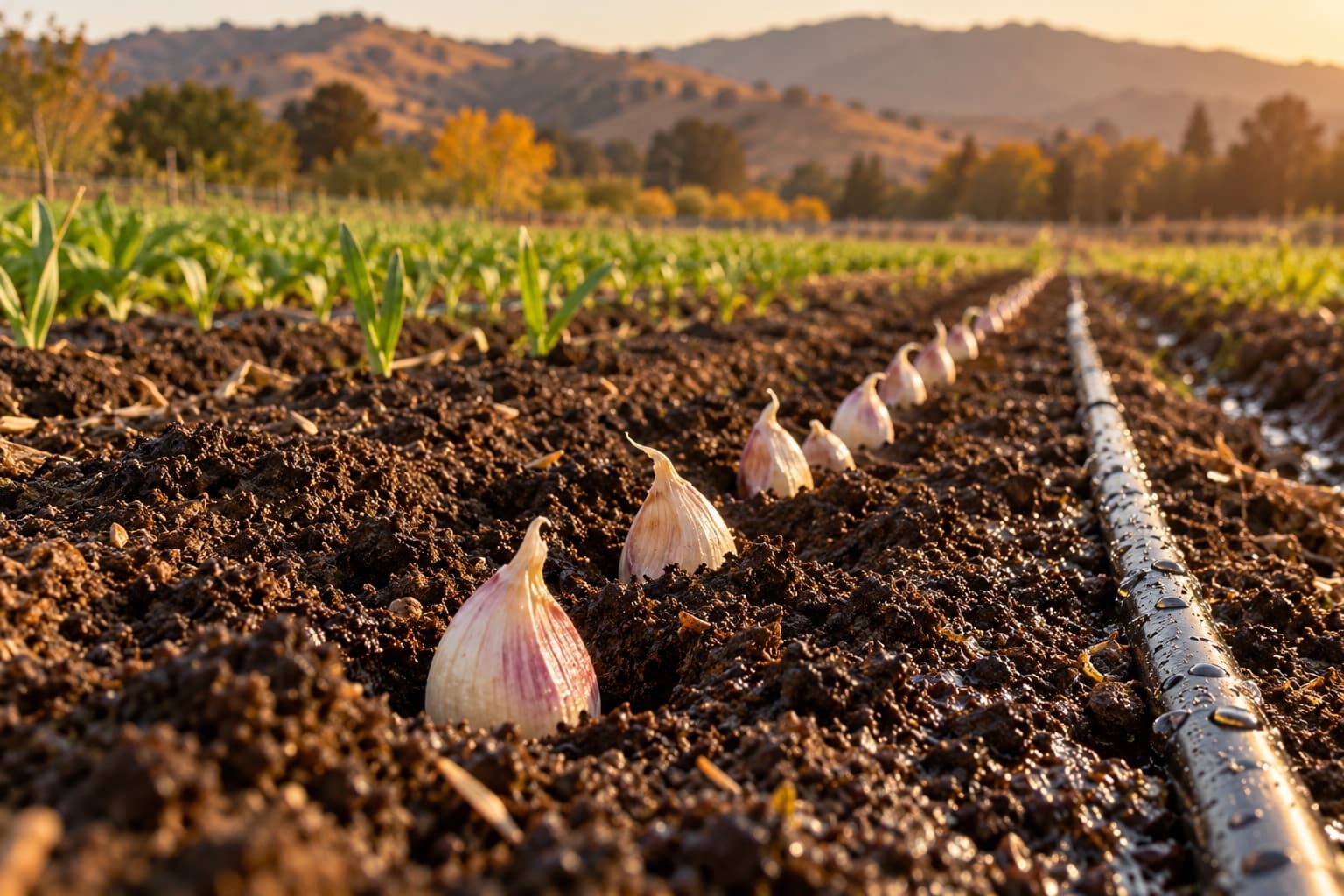
Garlic cloves set upright in dark, freshly watered soil beside a drip irrigation line in a California garden bed.

Regional months and their settings

When garlic goes in across California

North and north coast

Monterey County north, including the Bay Area and the coastal valleys

October to December, north of Monterey

Cool air and early rain. The season runs long here, so a December planting still has weeks of root growth before the soil cools further.

UC Statewide IPM's planting dates for onions and garlic, which match the UC Master Gardener Program's regional table.

South coast

San Luis Obispo County south, including Los Angeles and San Diego

October to December, south of San Luis Obispo

Mild nights and a marine layer. Softneck garlic handles the warmth better than hardneck, and the crop finishes before the dry season tightens.

UC Statewide IPM's planting dates for onions and garlic, which match the UC Master Gardener Program's regional table.

Interior valleys

The Sacramento and San Joaquin valleys

October to December in the valleys

Hot summers and cold valley nights. An October planting gives the roots warm soil to work in, and the winter chill that follows is what the clove needs to divide.

UC Statewide IPM's planting dates for onions and garlic, which match the UC Master Gardener Program's regional table.

Desert valleys

The Imperial and Coachella valleys

September to November

The earliest window in the state. Desert nights cool first, and the crop has to size before the next summer arrives.

UC Statewide IPM's planting dates for onions and garlic, which match the UC Master Gardener Program's regional table.

The water calendar

Rain does the work until spring

Before planting

Start with a full soil profile

UC's production notes ask for pre-plant irrigation or winter rain to bring the soil profile to field capacity by early spring. October beds in most of the state are still dry, and a clove planted into dust waits for rain that may not come.

UC Davis Vegetable Research and Information Center, Garlic production principles.

December to February

Let the rain work, then top it up

Normal winter rain usually supplies enough water. Butte County's Master Gardeners say to irrigate in winter when rainfall is low. The Marin County guide does not water on planting day at all, and lets the first storms settle the bed.

UC Master Gardeners of Butte County give the winter irrigation rule; the Marin County guide gives the planting-day advice.

March to May

Irrigate as the soil dries

Be ready to water when warm weather dries the bed between March and June. The crop uses about 15 inches of water across the whole season, which is a total rather than a monthly target.

Butte County's guide gives the spring irrigation timing; UC's production notes give the seasonal water use.

Late May and June

Cut the water before harvest

Marin County halves the water in May. UC's production notes stop irrigation when every clove in a bulb has formed and at least three to five wrapper leaves remain, which is earlier than waiting for the tops to fall over.

UC Master Gardeners of Marin County, Garlic; UC Davis Vegetable Research and Information Center.

Depth, mulch and stock

What goes wrong when a clove sits too shallow

UC's home-garden guidance plants cloves two inches deep and four inches apart, in rows twelve inches apart. The production notes allow half an inch to two inches, and plant deeper where the winter is colder. Marin County's guide plants one inch down. The differences follow soil and winter rather than a disagreement about the crop.

Mulch timing also splits. Butte County mulches at planting with compost, leaves or straw and pulls the cover back in spring. Marin County waits until the tops are up, which it puts in December for a November planting. Both keep moisture in and weeds down, which is the job in a dry autumn.

Depth and spacing from UC IPM and the Marin County guide; the depth range from UC's production notes; mulch timing from the Butte and Marin County guides.
Keeping the bed clean

Why the same ground cannot grow alliums twice

Rotate the bed. Butte County's Master Gardeners say not to plant garlic, onions, leeks or shallots in the same spot each year, because the diseases that attack one allium will attack the next.

Start from certified seed and keep the cloves whole until planting day. UC's production notes say cracked cloves do not keep long, because they dry out and pick up disease before they get into the ground.

  • White rot, Fusarium basal rot and purple blotch are the diseases UC names for the crop; stem and bulb nematode is the pest to keep out with clean stock.
  • Use virus-free seed garlic when a supplier offers it, and ask where the stock was grown.
  • Do not water on planting day if the soil is already moist. Wet, cold soil and a clove sitting in it is how a bed starts to rot.
Check California soil temperature
FAQ

Questions about garlic in California

Regional months, winter watering, planting depth and the rotation rule.

When should I plant garlic in California?

From October to December in the north coast, the south coast and the interior valleys, and from September to November in the desert valleys. The months come from the University of California's planting table for the state's four growing regions.

Can I plant garlic later than December in California?

Marin County's Master Gardeners allow planting from the middle of October to the middle of February, with fall plantings giving larger bulbs. Later planting is allowed, but the bulb has less time to size before the dry season.

How much water does garlic need in California?

About 15 inches across the season, from UC's production notes. Winter rain usually covers the middle of that. Irrigate when a dry winter or a dry spring leaves the bed short, and cut the water in late May as the bulbs finish.

How deep do you plant garlic in California?

Two inches is the home-garden figure from UC's pest management program, and the Marin County guide uses one inch. UC's production notes allow half an inch to two inches and plant deeper where winters are colder.

Why does my garlic rot before it sprouts?

Wet soil is the usual reason. Plant into ground that drains, do not water on planting day when the soil is already moist, and keep alliums out of a bed that grew them in the past two years. UC lists white rot and Fusarium basal rot as the diseases to watch.

Does garlic need frost to form a bulb?

No. Bulb formation responds to lengthening days, which is why California's mild gardens can grow garlic without a freeze. The cold the clove collects over winter still affects how well it divides, and hardneck types want more of it than the south coast gives.