GROWERBUDDY
Pennsylvania

When to plant garlic in Pennsylvania

Pennsylvania has no single garlic date, because the roots and the allium leafminer are working the same weeks. One plan waits until the garlic will only break the surface before winter; the other plants on the usual date and keeps the fly off the leaves with fabric.

Last updated: 2026-10-14• Sources

The short answer

WhereThe date behind itWhen to plant
SoutheastNovember 1Penn State's southeastern dateAround November 1
CentralMid-OctoberMid-Atlantic baselineMid-October, up to three weeks later in a warm season
Colder inlandAbout 2 weeksLater than usualAbout two weeks past your usual date
What goes in the groundA clove, not seed, set root end down with 1 to 1½ inches of soil over the top and 4 inches between cloves in triple rows. A shallower clove can be lifted by freezing and thawing; a deeper one can interfere with the growth of its own bulb.
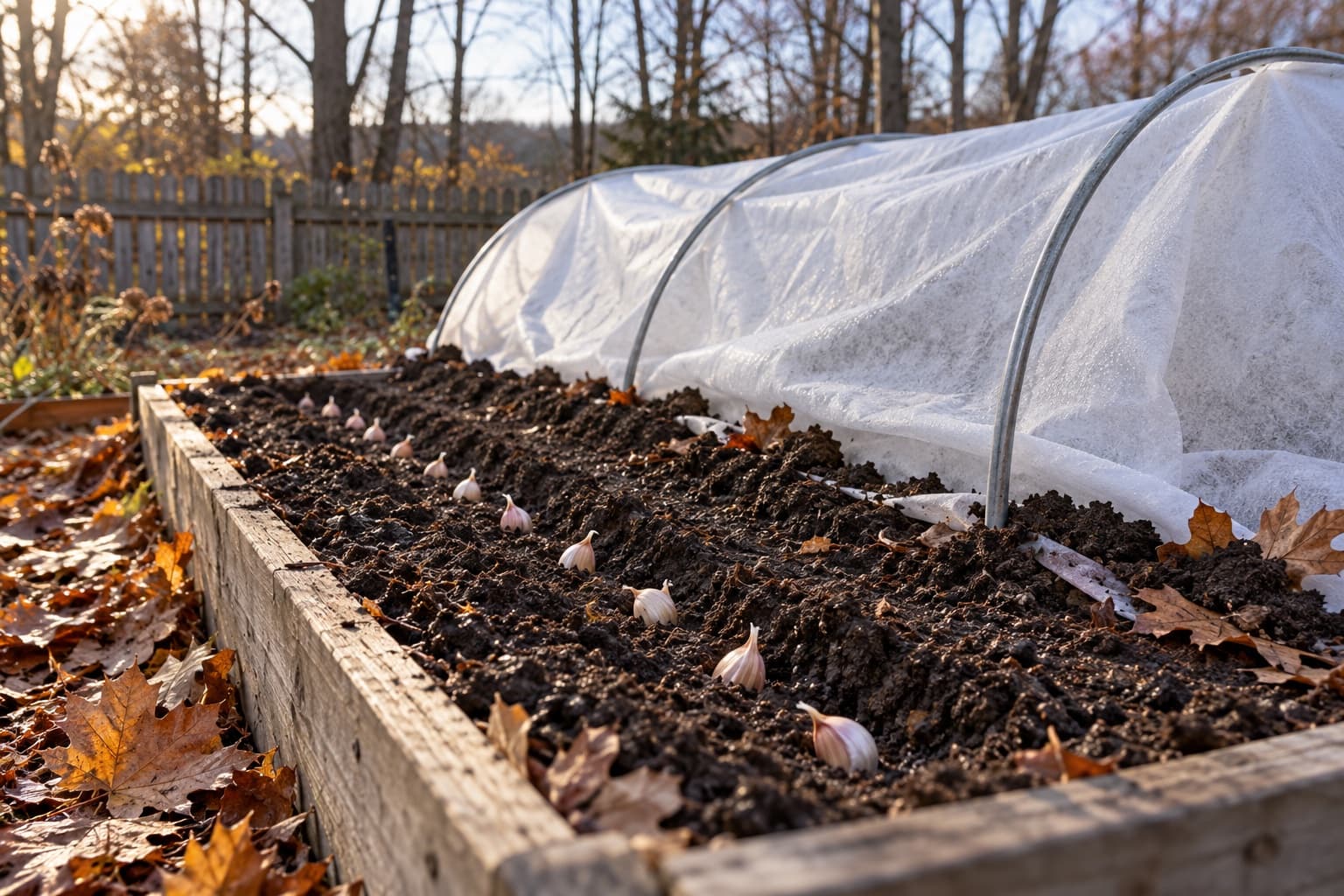
A late-autumn Pennsylvania garlic bed with cloves set in dark soil and white row-cover fabric stretched over hoops.

Plant garlic as late as your season allows while the ground is still workable, so the cloves root but go into winter with only a few inches of leaf. Penn State puts southeastern Pennsylvania near November 1 and colder parts of the state about two weeks past their usual date; the Mid-Atlantic guide puts central Pennsylvania in mid-October, about ten days earlier in a cool, short season and up to three weeks later in a warm one. A bed planted on the earlier date can do as well if it is covered through the fall flight: a covered bed answers the same problem as a later date.

Pennsylvania's fall window

Mid-October, later in the southeast and in warm seasons

The Mid-Atlantic commercial guide plants central Pennsylvania in mid-October and allows about ten days earlier in cool, short-season places and up to three weeks later in warm, long-season ones. Penn State's late-planting article reads the same autumn by region instead: near November 1 in the southeast, and about a fortnight past each garden's usual date in colder areas.

Mid-Atlantic Commercial Vegetable Production Recommendations, Garlic; Penn State Extension, Plant Garlic Late to Avoid Allium Leafminer.

  1. 01

    Two clocks run through a Pennsylvania autumn: the weeks of cool ground the roots need, and the five-to-seven-week flight the allium leafminer uses to lay its eggs in leaf.

  2. 02

    Penn State's answer is to plant as late as the season allows, so the garlic goes into winter with only a few inches of growth: near November 1 in the southeast, and about a fortnight past the usual date in colder parts of the state.

  3. 03

    The Mid-Atlantic commercial guide plants central Pennsylvania in mid-October, about ten days earlier in a cool, short season and up to three weeks later in a warm one, and gives the same pest reason for the later end.

  4. 04

    A covered bed is the other answer. Fabric on hoops, edges pinned or buried, goes on before the fall flight, comes off for winter and returns in March for the spring generation.

  5. 05

    Neither guide publishes a soil temperature to plant by, and a single hard freeze only marks one point at which a cover can come off; it does not end the fly's season.

The decision

Plant late, or plant on time under a cover

The roots want weeks in cool ground, and the fly wants leaf to puncture. Either plan keeps the cloves in the ground through winter; they differ in what the bed looks like during the weeks the fly is flying.

As late as the season allows

Plant late and keep the shoots short

Wait past your usual date while the bed is still workable, so the garlic goes into winter with only a few inches of growth. Penn State gives about November 1 for southeastern Pennsylvania, and moves a colder garden's October 1 habit to October 15. What matters is the height of the shoots, not the month: the female punctures leaf to lay her eggs, so a bed that has barely broken the surface has little to offer her.

The later the cloves go in, the less autumn the roots get before the ground freezes, and the Mid-Atlantic guide's own case for a fall planting is the root system and the winter cold a clove collects. This plan also covers one flight only: Penn State says spring brings another generation looking for a host, so the cover is still part of the season.

Penn State Extension: Plant Garlic Late to Avoid Allium Leafminer
Fabric on before the flight

Plant on your usual date and cover the bed

Use the date your region normally plants and put a barrier over the bed for the September and October flight. Penn State's prevention guide calls a row cover the most effective protection, and gives the routine: garden fabric on hoops so it never touches the leaves, edges pinned to the ground or buried, on at planting in the fall, off for winter, and back in March for the spring generation.

The fabric has to be in place before the adults are active, and the bed underneath it has to be clean. Penn State's alert asks growers to scout first so a cover does not trap flies that are already in the crop, and its prevention guide asks whether any allium grew in that ground during the past year, because pupae there come up under the fabric.

Penn State Extension: Preventing Allium Leafminer in Garlic Plantings

Neither plan finishes the work in autumn. Penn State's own late-planting article says the delay does not protect garlic through harvest, because the spring generation returns to lay eggs on the new leaves. The cover goes back on in March in both plans.

Three readings of the state

Which Pennsylvania date applies to your garden

The two guides measure the state differently. Penn State gives the southeast a date and colder parts of the state an offset from each garden's own habit; the Mid-Atlantic guide states one baseline month for central Pennsylvania and widens it for cool and warm seasons.

Southeastern Pennsylvania

Around November 1

The late date is the point. Penn State's horticultural educator advises planting as late in the autumn as possible so the garlic grows only a few inches before winter, which leaves too little leaf for the fly to puncture and lay eggs in. Plant while the ground can still be worked: the date is a calendar example for the region, not a reading from your own soil.

Who this covers
Gardens in the southeast, the part of the state Penn State's late-planting article writes a calendar date for. It is the latest of the three readings, and it is given as a date where the other two are offsets from each garden's own habit.

Penn State Extension, Plant Garlic Late to Avoid Allium Leafminer, updated September 8, 2025.

Central Pennsylvania

Mid-October, up to three weeks later in a warm season

Cloves go in during mid-October here, about ten days earlier in a cool, short-season area and up to three weeks later in a warm, long-season one. The guide's reason for the later end is the same pest as Penn State's: where the fall generation of allium leafminer is present, its growers are told to plant as late as possible to escape the damage.

Who this covers
The middle of the state, where the Mid-Atlantic commercial guide states its baseline month. The guide widens that month for two kinds of season, not for two kinds of place, so a warm autumn is a reason to move later.

Mid-Atlantic Commercial Vegetable Production Recommendations, Garlic chapter.

Colder inland gardens

About two weeks past your usual date

The instruction is written as an offset: consider planting about two weeks later than usual, which turns an October 1 habit into October 15 in Penn State's example. The offset is measured from each garden's own habit, and it is the form the colder areas of the state are given where the southeast has a date.

Who this covers
Higher, inland and northern gardens whose usual date is already earlier than the southeast's. Penn State's example starts from a garden that plants around October 1.

Penn State Extension, Plant Garlic Late to Avoid Allium Leafminer, updated September 8, 2025.

The pest's own calendar

What allium leafminer does in a Pennsylvania year

The fly works on two flights a year with a summer rest between them, and the planting decision sits inside the second one. These are the parts of that cycle a date can use.

Allium leafminer is a small fly that reached North America in Lancaster County, where it was first detected in 2015. Penn State's late-planting article says it has spread since then and is probably throughout Pennsylvania, so the pest half of the decision applies wherever the bed is.

The fly has two generations a year. Adults emerge in spring, feed and lay eggs for five to seven weeks, and the larvae that hatch mine down through the leaf towards the bulb. The next stage is a pupa that rests through the summer, and a second adult flight begins in late September to repeat the cycle on whatever allium leaves are still growing.

The mark that settles it is the line of small white dots the females leave when they puncture a leaf to lay eggs. It shows up on garlic, onions, shallots, chives, leeks and wild onions, which is why a look at wild onions or an unharvested onion bed tells you whether the fly is working in your area. The start of each flight moves with the season, so the current alert is worth checking where a fixed date is not.

2015
First detection in the state

Allium leafminer was first found in Lancaster County in 2015 and has spread through the state since. Penn State now describes it as probably present throughout Pennsylvania.

Penn State Extension, Plant Garlic Late to Avoid Allium Leafminer, updated September 8, 2025.

2
Generations a year

One generation flies in spring, the next in autumn. Between them the insect rests as a pupa through the summer, which is why a planting timed after the fall flight leaves it very little leaf to use.

Penn State Extension, Allium Leafminer Emerging Now in Southeastern PA, updated September 19, 2024.

5 to 7 weeks
Length of one adult flight

Penn State gives five to seven weeks for the spring flight and the same span for the fall generation that begins in late September. A flight that long is why the fabric stays on even after a quiet week.

Penn State Extension, Allium Leaf Miner on Track to Emerge in Early April, updated March 28, 2025.

Late September
When the fall flight starts

Penn State describes the second generation as emerging in late September, and its 2024 scouting found the fall emergence in Lancaster County on September 18. The date shifts with the weather, so its alert is the current answer.

Penn State Extension, Allium Leaf Miner on Track to Emerge in Early April, 2025; Allium Leafminer Emerging Now in Southeastern PA, 2024.

4 to 6 weeks
How long a cover stays on

Penn State's cover advice runs from before the flight to the end of adult emergence, generally four to six weeks, or to the first hard freeze. Either ending takes the fabric off; neither is written as proof that every adult has gone.

Penn State Extension, Allium Leafminer Emerging Now in Southeastern PA, updated September 19, 2024.

Where the evidence stops

What the two plans establish, and what they leave open

Both guides answer the same question in different units. Penn State's instruction is about shoot growth, measured in the inches of leaf a late planting allows. The Mid-Atlantic guide's is a calendar month for a region, widened at both ends of the season. Neither publishes a soil temperature to plant garlic at, so there is no number to read from a thermometer and no single date that is right for the whole state.

The cold requirement in the Mid-Atlantic guide is a separate measurement. Garlic needs 32 to 50°F for about two months before the long days that start bulb formation, and a fall planting is how a clove collects that cold naturally. That is a winter exposure the plant needs, not a soil temperature to plant by, and it says nothing about how many weeks of autumn roots a clove wants before the ground freezes.

A hard freeze belongs to the cover advice, not to the planting advice. Penn State lists the first hard freeze beside the end of adult emergence as a point at which the fabric can come off. It is not offered as the end of every adult, and it cannot remove eggs or larvae already inside a leaf. The insect also overwinters in the state and returns on the spring flight, so nothing about autumn timing changes what the spring generation does.

  • Neither guide publishes a soil temperature for planting day. The October dates are regional months, and Penn State's delay is counted in leaf growth, not degrees.
  • The 32 to 50°F for about two months is the winter cold that lets a clove divide into bulbs, not a check to run in the planting bed.
  • A first hard freeze is one of two points at which a cover can come off, beside the end of adult emergence. It is a cover-removal point, not a statement that the flight has ended.
  • Fall timing answers the fall flight alone. The spring generation lays eggs on the new leaves, so a March cover belongs to both plans.
  • Penn State keeps current leafminer alerts because the flight start moves with the season. Check the latest one before you rely on a month.
Late, frozen out, or already planted

What to do when the window has closed

The verge, the frozen bed and the planting that is already in the ground ask for three different answers. None of them is a second chance at the recommended window.

You are past your date and the ground still works

Plant the cloves. A late planting still gives the roots the weeks that are left, and the later end is the one both guides lean towards for pest reasons. Work the bed when the soil is neither frozen nor wet enough to smear, and keep the mulch and winter cover you normally use.

Expect less root growth before the ground freezes than an early planting gives, and do not count on spring making the difference up. The Mid-Atlantic guide's case for a fall planting is the root system and the winter cold it collects, so a short autumn is what a late date costs.

Mid-Atlantic Commercial Vegetable Production Recommendations, Garlic chapter; Penn State Extension, Plant Garlic Late to Avoid Allium Leafminer.

The bed is frozen, or wet enough to smear

Leave the bed. Penn State's dates are calendar examples for an open season, not a reason to work frozen or waterlogged soil. Plant the cloves in early spring, or hold them for next autumn.

The Mid-Atlantic guide allows spring-planted garlic where it can go in by early March, and names Elephant garlic as the type for it. A spring crop misses the natural cold treatment a fall planting collects, so expect less than a fall planting gives.

Mid-Atlantic Commercial Vegetable Production Recommendations, Garlic chapter.

You have already planted in early autumn

Do not lift healthy cloves. Cover the bed if the fabric can go on before the adults are active, or leave it for the March cover, and watch the leaves for lines of white dots. A plant with those marks is infested, and Penn State says there is no cure: pull and bag the affected material instead of composting it, and do not keep those bulbs for replanting.

Infested plants carry on with stunted growth and smaller bulbs, and the larvae can leave a bulb open to rot. The insect pupates in leaf tissue and nearby soil, which is why the guide asks for at least a year without an allium crop in that ground and a bed cleared of plant debris after harvest.

Penn State Extension, Preventing Allium Leafminer in Garlic Plantings, updated September 22, 2021.

Before the cloves go in

  • Check what grew in that ground last year. Penn State asks for at least a year without an allium crop, and longer if your space allows it.
  • Break the bulbs into cloves just before planting and keep the largest for the garden. The Mid-Atlantic guide drops long slender centre cloves and cloves under a gram from the planting list.
  • Have the cover and its hoops ready before the flight, because the fabric has to be in place before the adults are active in the bed.
  • Plan for spring as well as autumn. The overwintering generation emerges in late March, and the cover goes back on for it.
FAQ

Questions about Pennsylvania garlic

Check the regional dates, the leafminer plan, and what to do when you are late.

When should I plant garlic in Pennsylvania?

Plant as late as your season allows while the ground is still workable. Penn State gives about November 1 for southeastern Pennsylvania and about two weeks later than usual for colder parts of the state. The Mid-Atlantic guide plants central Pennsylvania in mid-October, with about ten days earlier in a cool, short season and up to three weeks later in a warm one.

Is allium leafminer a problem everywhere in Pennsylvania?

Penn State says it is probably throughout the state after its first detection in Lancaster County in 2015, so the pest question applies wherever you garden. What changes by region is the date the advice is written for. Scout the wild onions and any unharvested onion or leek plants near you for the lines of white dots.

Should I wait for a frost before planting garlic?

Neither guide uses a frost as the planting cue. Penn State counts the delay in leaf growth, and the Mid-Atlantic guide gives regional months. A frost has one place in the advice: the first hard freeze is one of the two points at which Penn State allows a row cover to come off, the other being the end of adult emergence.

Does a late planting protect garlic from allium leafminer through harvest?

No. Penn State says the fall delay avoids the work of covering the crop twice, but it does not protect the plants through harvest, because the spring generation lays eggs on the new leaves. The floating row cover, put back on in March, is what covers that flight.

I planted garlic in early October. Should I pull it?

No. Healthy cloves are worth keeping, and the date alone does not make a plant infested. Cover the bed if the fabric can go on before the adults are active, and look for the puncture lines on the leaves. A plant that carries them has no cure, so remove and bag that material, and keep alliums out of the ground for at least a year.

Does garlic need cold in Pennsylvania?

Yes. The Mid-Atlantic guide gives 32 to 50°F for about two months before the plant can begin forming bulbs, and says the natural cold treatment a fall planting collects along with its root system is what produces the highest yields. A Pennsylvania winter usually supplies the temperatures; the planting date decides how much root growth comes before them.

How deep and how far apart should the cloves go?

The Mid-Atlantic guide covers the tops with 1 to 1½ inches of soil and sets cloves 4 by 4 inches apart in triple rows, with the root end down. Cloves that sit too shallow can be lifted by freezing and thawing, birds or rain, and cloves that sit too deep can have their bulbs crowded by soil.